
Download the app


© 2026. The Purpl Co Limited. All rights reserved.


Download the app
© 2026. The Purpl Co Limited. All rights reserved.
6 min read
Written by
Georgina, Founder of Purpl
Published on
December 31, 2025
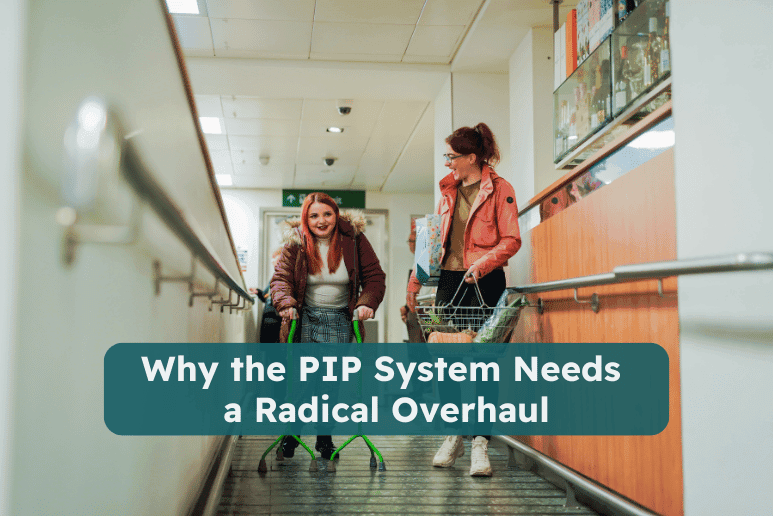
Personal Independence Payment (PIP) faces renewed scrutiny as the UK debates reforms to disability benefits. Many headlines focus on process — assessment backlogs, decision-making quality, and how reviews operate. However, a deeper issue sits underneath: the assessment framework works best when disability presents as a physical task problem, and it often struggles when disability creates access barriers (for example, distress, shutdown, overwhelm, or cognitive load).
This article focuses on why the current assessment model can miss mental health and neurodivergent disabilities (and what fair reform should consider). For rolling updates on confirmed and proposed policy changes, see: PIP Reform 101: Latest Update on Personal Independence Payment (PIP) Changes and PIP and Disability Benefits in 2025: What’s Changing.
In UK rules, PIP aims to assess how a condition affects daily living and mobility in real life — not a diagnosis label. Official assessment guidance and the regulations behind PIP set out that principle. The problem is not “invisible disabilities are not real”. The problem is that the current wording of the questions can miss how invisible or fluctuating disabilities restrict daily life. (See the PIP Assessment Guide on GOV.UK and the PIP Regulations on legislation.gov.uk: PIP Assessment Guide (Part 2) and PIP Regulations 2013 (Regulation 4).)
Core point: A fair assessment needs to measure whether disabled people can access daily life safely and reliably — not whether tasks look possible “on paper”.
Confirmed operational changes (from April 2026): DWP has announced changes including extending review periods for many PIP claimants aged 25+ (minimum 3 years for a new claim, rising to 5 years at the next review if entitlement continues) and increasing face-to-face assessments. (See DWP press release: Reforms to welfare system set to save £1.9 billion by the end of 2030/31.)
Proposed policy direction: The Government’s Pathways to Work Green Paper sets out proposals including a new additional eligibility requirement for the PIP daily living component (minimum 4 points in at least one daily living activity), plus a review of the PIP assessment. (See: Pathways to Work Green Paper.)
PIP measures functional impact on daily living and mobility using activities. In theory, that should improve fairness because it does not rely on a diagnosis alone. In practice, the framework can create gaps when disability does not present as a straightforward physical limitation.
Physical impairments often determine whether someone can do a task. Mental health conditions and neurodivergent disabilities often determine whether someone can start the task, tolerate it, and complete it safely — especially when distress, sensory overload, executive dysfunction, or shutdown play a part. (See: NHS England: Adult and older adult mental health.)
Purpl Insight: Sometimes the biggest barrier is not the task itself — it is the ability to access the task without harm.
UK rules and official guidance require decision makers to consider whether someone can complete an activity safely, to an acceptable standard, repeatedly, and within a reasonable time. (See Regulation 4 and the DWP assessment guide PDF: PIP Assessment Guide (Part 1 PDF).)
That matters because a person may be physically capable of a task, but not able to do it reliably in real life due to distress, cognitive impairment, panic, dissociation, sensory overload, or the need for supervision to stay safe.
Purpl Tip: When describing difficulties, linking the impact to safety, reliability and repeatability keeps evidence aligned to the legal and guidance tests — not personal opinion.
Washing and bathing is a clear example of how descriptors can disadvantage people when disability is primarily psychological or cognitive.
A repeated pattern runs through many daily living activities: the assessment can focus on whether a task is physically possible, rather than whether daily life is accessible without harm.
PIP exists to help with the extra costs of disability and long-term health conditions, but the current assessment structure can fail to reflect how many disabilities affect everyday living — particularly where disability presents as access barriers rather than physical task limitations.
As policymakers debate reforms, meaningful improvement needs more than process tweaks. Fairness depends on capturing whether people can access daily life safely and reliably — not whether a task looks possible in theory.
No. PIP is designed to assess how a condition affects daily living and mobility in real life, rather than awarding based on diagnosis alone. The assessment uses activities and descriptors, and decision making is meant to reflect functional impact. (See DWP PIP Assessment Guide (Part 2).)
In PIP, an activity should be considered in terms of whether it can be done safely, to an acceptable standard, repeatedly, and in a reasonable time. This principle is set out in the PIP Regulations and reflected in assessment guidance. (See PIP Regulations 2013, Regulation 4 and PIP Assessment Guide (Part 1 PDF).)
Yes. Mental health conditions can qualify if they have a long-term impact on daily living and/or mobility activities as described in the PIP criteria. The focus is on functional impact, including the need for prompting, supervision, or support to stay safe and complete activities reliably. (See NHS England: Adult and older adult mental health and DWP PIP Assessment Guide (Part 2).)
Neurodivergent disabilities can affect initiation, sequencing, sensory tolerance, distress, and shutdown — which can make everyday activities inaccessible even if tasks appear physically possible. The challenge is translating access barriers into evidence that clearly shows safety, reliability, and repeatability in real-world conditions.
Evidence that links day-to-day impact to the PIP activities tends to be the most useful. Examples can include clinical letters, care plans, prescriptions, and real-life examples that show what happens on bad days and typical days, and whether support is required to do activities safely and repeatedly.
This page focuses on how the assessment model can miss mental health and neurodivergent disability. For confirmed and proposed policy updates by year, use: PIP Reform 101: Latest Update on Personal Independence Payment (PIP) Changes and PIP and Disability Benefits in 2025: What’s Changing.
Georgina is the founder of Purpl, a platform dedicated to helping disabled people save money through exclusive discounts. Living with both Multiple Sclerosis (MS) and ADHD, she understands firsthand the financial challenges that often come with managing a disability. Because of this, her mission is to collaborate with brands to secure discounts that help ease the cost of essential products, services, and everyday expenses for the disabled community.
As an ambulatory wheelchair user, Georgina also knows how it feels to lose a sense of independence due to a disability. For that reason, she’s deeply passionate about using holistic therapies and diet to manage inflammation and stay as healthy as possible. Ultimately, her goal is to make Purpl a trusted, go-to resource for disabled people — one that provides not only discounts but also practical advice, emotional support, and genuine financial relief.
Beyond Purpl, Georgina has a long-term vision to launch a foundation that will offer grants and funding for disabled people who need additional financial support. Through this, she hopes to create lasting change, empowering others to live with dignity, confidence, and choice.
Follow @Purpldiscounts on social media for the latest disability discounts, financial advice, and accessibility resources.
Other articles, or links, you might find useful:
How to Apply for PIP and Maximise the Benefits in the UK
DWP Confirms Small Benefits Increase for PIP, Carer’s Allowance & More
Going Abroad On PIP: The 4-Week Rule That Could Pause Your Payments
How to Challenge a PIP Decision in the UK: What to Do If Your Claim Is Refused or Underpaid
PIP Reform 101: Latest Update on Personal Independence Payment (PIP) Changes
PIP Discounts and Freebies 2026: Maximise Savings with your PIP Benefits
How are PIP Points Given? Understanding PIP Descriptors