
Download the app


© 2026. The Purpl Co Limited. All rights reserved.


Download the app
© 2026. The Purpl Co Limited. All rights reserved.
19 min read
Written by
Georgina, Founder of Purpl
Published on
September 9, 2026
Last reviewed: 9 September 2026
Applies to: England, Wales, Scotland and Northern Ireland
Written by: Georgina, Founder of Purpl
Explaining a fluctuating health condition or disability on a Personal Independence Payment (PIP) or Adult Disability Payment (ADP) form can feel like trying to squeeze the reality of your daily life into a few boxes.
And when you are already dealing with pain, fatigue, flare-ups or brain fog, trying to remember exactly what happened weeks or months ago can be really difficult. Important details can easily get missed.
The free Purpl PIP Tracker helps by letting you record symptoms, daily difficulties, support needs and how your condition affects you as things happen. Over time, those entries build into a clear, time stamped record that you can look back on when preparing a PIP or ADP application, review, challenge or appeal.
Although it is called the Purpl PIP Tracker, it can also be used for Adult Disability Payment in Scotland because ADP considers the same 10 Daily Living activities and two Mobility activities. Social Security Scotland also applies the same four reliability questions when looking at how someone completes an activity.
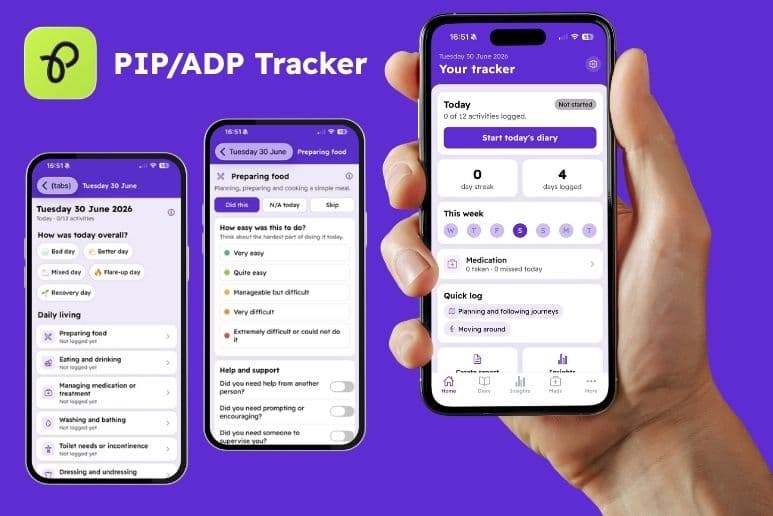
The Purpl PIP Tracker is a free digital symptom diary that helps people with disabilities and long term health conditions record how their condition affects everyday life.
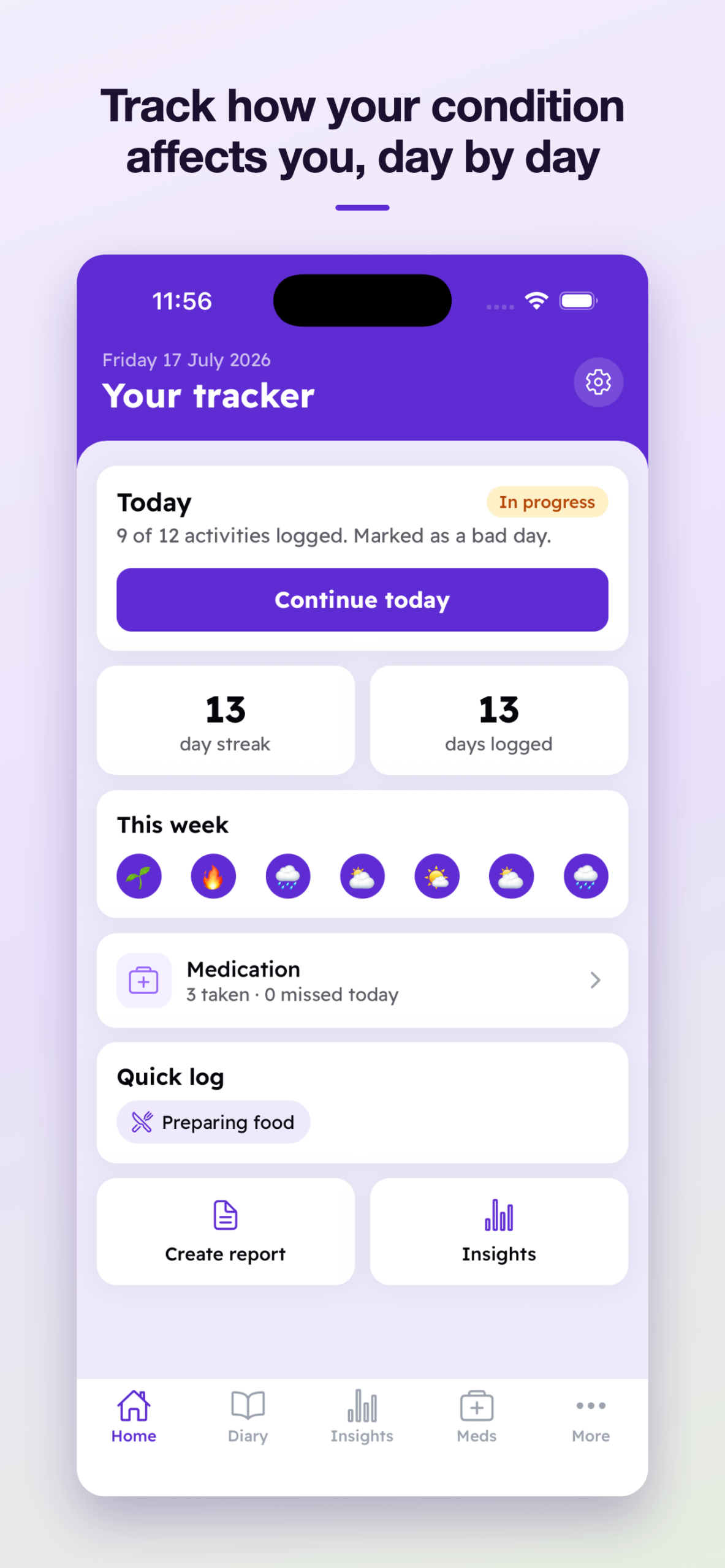
It can help you build a daily record for:
The tracker gives you one structured place to record:
Rather than trying to rebuild months of difficult days from memory when a form lands, you can record what happened while it is still fresh in your mind.
Citizens Advice says keeping a diary can be helpful if your condition fluctuates because it allows you to record difficult days and how they affected you. You can also use a diary to help complete your PIP form (Citizens Advice).
The freedom to enter what I like or skip what I don’t need makes it fit.
James, Purpl member
Purpl Insight: The tracker will not tell you whether you qualify for PIP or ADP. What it does is give you a much easier way to keep a record of your own experiences.
A daily diary can help you remember specific examples of how your condition affects you.
Motst of us know when something is difficult, but remembering the exact detail months later is another matter.
When completing a disability benefit form, you may know that you struggle regularly but find it much harder to answer questions such as:
A diary helps turn general statements such as:
“I struggle with cooking quite often.”
into something more specific, such as:
“Over the last four weeks, I needed help preparing food on 18 days because of weakness, pain and fatigue.”
For PIP, DWP looks at how your condition affects your ability to complete 12 Daily Living and Mobility activities, rather than simply looking at your diagnosis (Citizens Advice).
Adult Disability Payment works in a similar way. Social Security Scotland says ADP has a Daily Living part and a Mobility part, and the amount you receive depends on how your condition affects everyday activities and getting around (mygov.scot).
Purpl Tip: Record what happened before, during and after an activity. If doing something wipes you out for the rest of the day, that is worth recording too.
One of the most common things we hear from disabled people is:
“I wish I’d started keeping a diary sooner.”
By the time a PIP or ADP form arrives, you may suddenly be trying to remember months of:
If the first decision is wrong, the process can continue through a Mandatory Reconsideration for PIP, a re-determination for ADP, and sometimes an appeal.
The latest Ministry of Justice tribunal statistics show that 67% of PIP decisions cleared at a tribunal hearing between January and March 2026 were overturned in favour of the claimant (GOV.UK).
That does not mean that keeping a diary guarantees the right decision or that every PIP decision is wrong.
What it does show is why having clear, specific information about your day-to-day life can be so useful from the start.
Having to challenge a decision through an appeal process, like a Mandatory Reconsideration, Scottish re-determination or tribunal, is exhausting and stressful.
When you are already living with a disability or health condition, the last thing you need is another huge piece of admin.
People are constantly told to keep a diary, but nobody makes that particularly easy.
That is why we built the free Purpl PIP Tracker. I want people to record real examples as they happen instead of sitting in front of a form months later trying to remember every difficult day.
We named it the Purpl PIP Tracker because PIP is the name most people recognise, but it works just as well for Adult Disability Payment in Scotland. The same 12 Daily Living and Mobility areas are covered, so people in Scotland can use it to build the same kind of day-to-day record.
Our goal isn’t to tell people what award they should get. It is to help them explain what life is actually like, with clear examples ready when they need them.“
Georgina, Founder of Purpl
The Purpl PIP Tracker can be useful at different stages of a PIP or ADP claim.
Start building a record before or while completing your application.
Record how your condition continues to affect you or how your needs have changed before your review paperwork arrives.
When my PIP reassessment happens, I have all of the information to hand.
Annie, Purpl member
If you disagree with a PIP decision, your diary can help you organise examples when asking DWP to look at the decision again.
If you disagree with an Adult Disability Payment decision, you can ask Social Security Scotland to look at it again. This is called a re-determination (Citizens Advice Scotland).
Your diary can help you organise a clear timeline if you later need to discuss your case with a welfare rights adviser, representative or tribunal.
A carer, family member or supporter can help you record information if your disability makes it difficult to complete the diary yourself.
Purpl Tip: You do not need to wait for a form to arrive. Starting earlier means you may already have useful examples ready when you need them.
The app is designed to make daily recording quick and manageable.
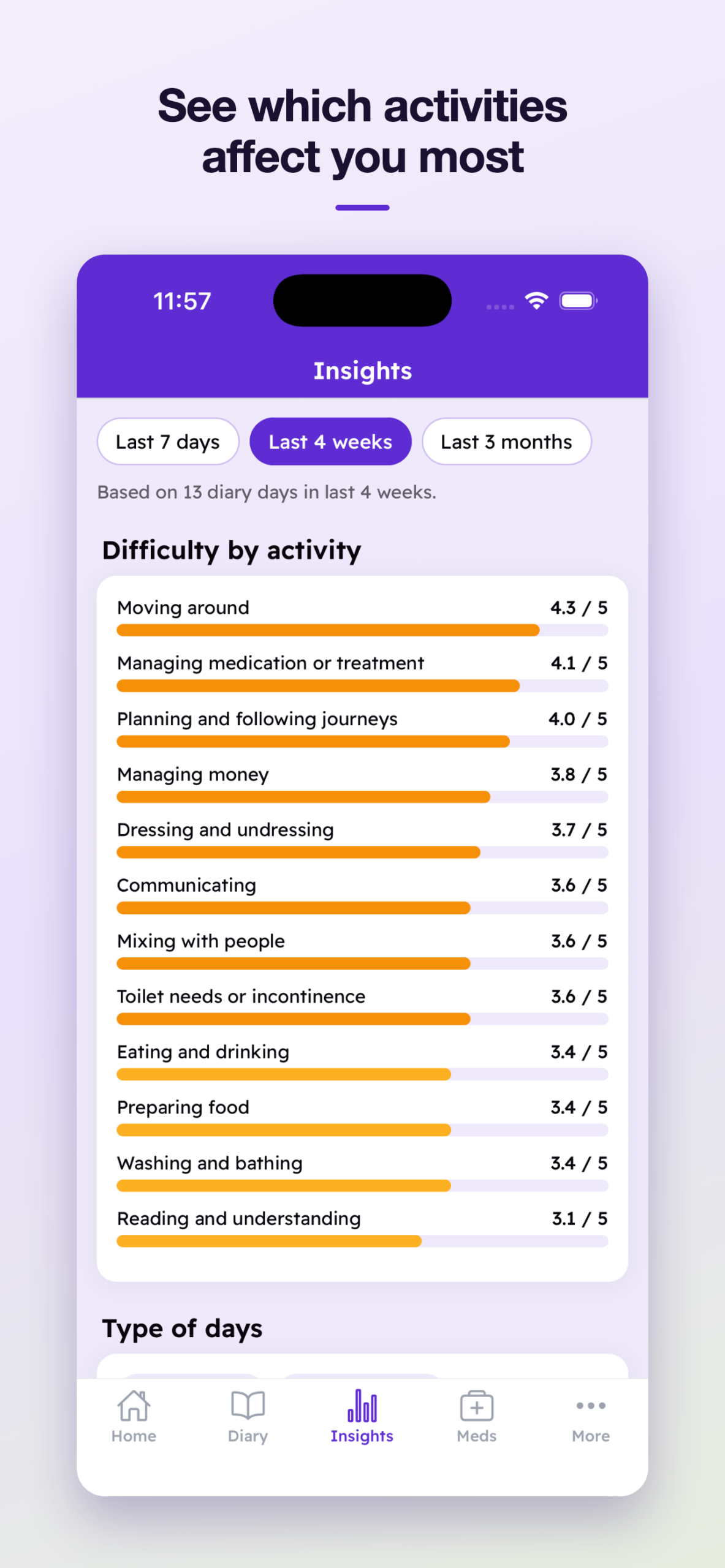
You can record things such as:
You can also record how difficult relevant everyday activities were.
Instead of only asking whether you completed something, the tracker helps you record what it actually took to do it.
For example, you might record that an activity:
You do not need to write pages every night. A few clear details about what happened can build a much stronger picture over time.
I’ve been using the app for 3 weeks now. I love the ability to skip the parts I don’t want to fill in and the free text entry allows me to diarise other things that affect my mood or cause more anxiety and stress.
The freedom to enter what I like or skip what I don’t need makes it fit.
James, Purpl member
Purpl Tip: Think specific rather than long. A short real-life example can tell you much more than a paragraph of general information.
Not everything that affects your daily life fits neatly into one of the 12 PIP and ADP activities.
That is why the Purpl PIP Tracker also lets you record how you are feeling each day, separately from the Daily Living and Mobility activities.
You can rate any areas that affected you that day from 1 to 5, where 1 is mild and 5 is very severe, including:
You do not have to complete every area every day. Just record the things that were relevant to you.
I can check any day, without having to try and remember.
Claire, Purpl member
This can help build a much fuller picture of how your disability or health condition changes over time. It may also help you spot connections that are easy to miss when looking at individual days.
For example, you might notice that poor sleep is followed by worse fatigue and brain fog, or that doing more one day leads to a longer recovery period or greater difficulty with everyday activities afterwards.
It also means you can keep a record of the wider impact of your condition, even where something does not fit neatly within a specific PIP or ADP activity.
Purpl Insight: Your disability is bigger than a list of benefit descriptors. Recording how you feel each day alongside the PIP and ADP activities can help you build a more complete picture of how your condition actually affects your life.
Because ADP in Scotland uses the same 10 Daily Living activities and two Mobility activities as PIP, the tracker organises your notes around the 12 areas considered by both DWP and Social Security Scotland.
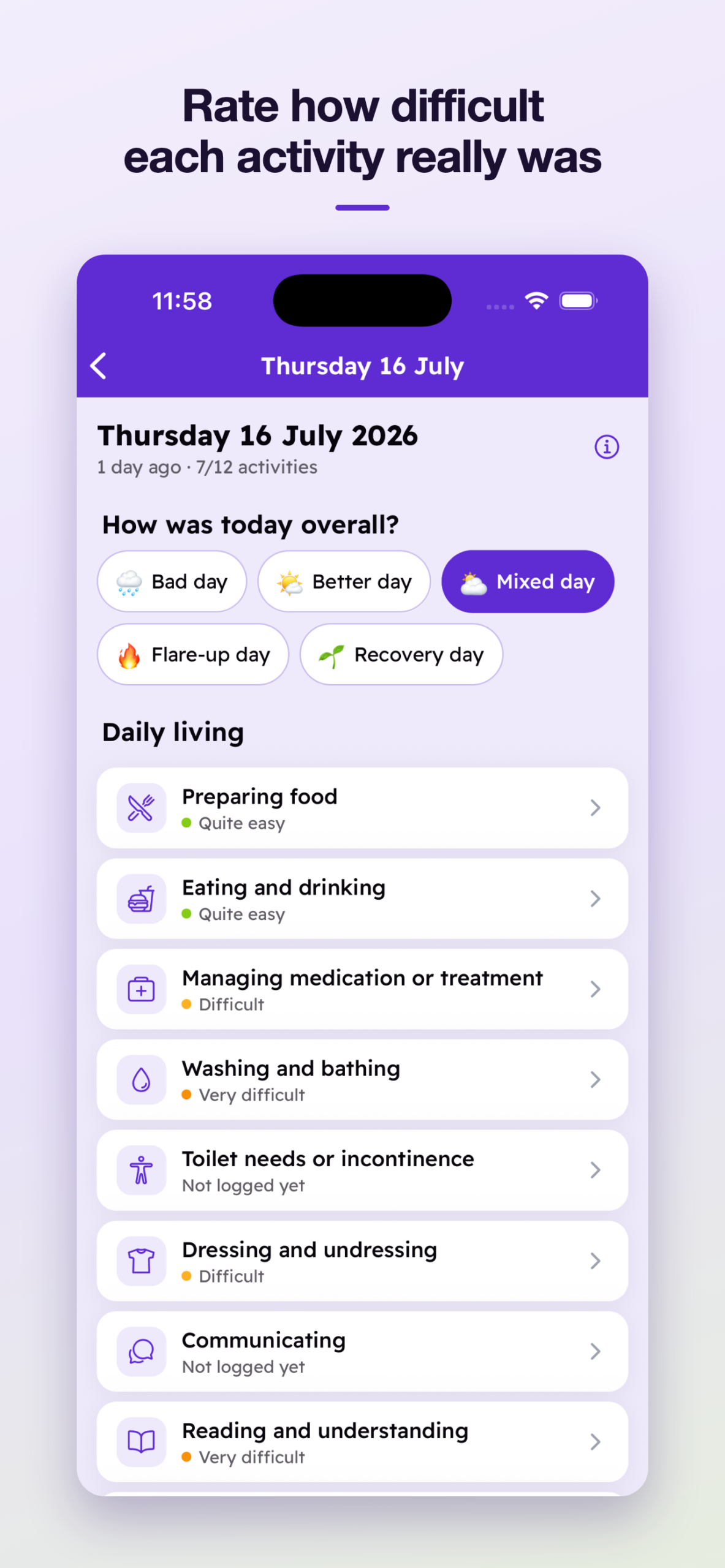
The detailed PIP rules are set out in the DWP PIP assessment guide.
Social Security Scotland publishes its own Adult Disability Payment decision-making guidance for ADP.
Purpl Insight: You do not need to learn the official wording before you start. The tracker uses plain English so you can concentrate on what happened to you.
For both PIP and ADP, it is not enough to look only at whether you managed an activity once.
The question is whether you can do it reliably.
DWP says PIP activities should be considered according to four reliability tests (GOV.UK).
Social Security Scotland uses the same four reliability questions for Adult Disability Payment (Social Security Scotland).
Could you do the activity without an unacceptable risk of harm to yourself or somebody else?
Examples might include:
Could you do the activity well enough?
For example, you might technically finish washing or dressing but not be able to do it properly because of pain, weakness or another symptom.
Could you do it as often as you would reasonably need to?
For example, you may be able to prepare breakfast but become too exhausted to prepare another meal later.
Could you complete the activity without it taking much longer than someone without your disability?
For PIP, a reasonable time means no more than twice as long as a non-disabled person would normally take to complete the activity (GOV.UK).
This is exactly the sort of detail that can be hard to remember months later, which is why recording it as you go can help.
| Reliability question | What it means in everyday language | Example |
|---|---|---|
| Safely | Can you do it without a serious risk of harm? | You drop hot cookware because of sudden weakness or muscle spasms. |
| To an acceptable standard | Can you complete it properly? | You try to wash but cannot wash yourself properly because of severe pain. |
| Repeatedly | Can you do it as often as you reasonably need to? | You prepare breakfast but are too exhausted to prepare lunch. |
| In a reasonable time | Can you do it without taking much longer than someone without your disability? | Dressing takes far longer because of pain and stiffness. |
Purpl Tip: If you managed an activity once but could not repeat it later when you reasonably needed to, record that too.
The tracker helps you record how your condition changes from one day to another.
This can be particularly useful for conditions where symptoms are unpredictable or vary in severity.
That might include conditions such as:
Both PIP and ADP rules recognise that needs can fluctuate.
For PIP, DWP says assessors should consider ability across a 12-month period, broadly looking at the three months before assessment and nine months afterwards. A scoring descriptor can apply where the person’s condition affects their ability to complete the activity on more than 50% of days (GOV.UK).
Adult Disability Payment also uses rules for deciding which descriptor applies where needs vary on different days.
The Purpl PIP Tracker can show patterns in the days you have actually recorded.
For example, instead of saying:
“Preparing food is difficult quite often.”
your tracker might show:
“Preparing food was affected on 20 of the 28 days I recorded.”
That gives you something much more concrete to refer back to.
However, it does not mean the tracker has decided that you meet the legal 50% rule.
DWP or Social Security Scotland still decides which descriptor applies using all the relevant information.
The tracker can also help show:
Purpl Insight: The app cannot decide whether you meet the 50% rule, but it can make it much easier to see and explain your own pattern over time.
What you write does not need to sound formal. It just needs to explain clearly what happened.
Basic entry:
“Showered today.”
More useful diary entry:
“Managed to shower using my bath board. My partner had to wash my hair because my shoulders were too weak. I then needed to lie down for two hours because of dizziness and exhaustion.”
Basic entry:
“Walked to the shop.”
More useful diary entry:
“Walked around 50 metres to the local shop using my crutch. It took about 15 minutes because of ankle pain and breathlessness. I could not walk that distance again for the rest of the day.”
Basic entry:
“Didn’t leave the house.”
More useful diary entry:
“I could not attend my GP appointment because of severe panic and distress. My carer encouraged me for around 45 minutes, but I still could not leave the house.”
These entries explain:
Purpl Tip: Imagine reading the entry three months later. Would you still know what happened and why it was difficult? If not, add one or two more details.
If the DWP or Social Security Scotland gives you a decision you disagree with, you can challenge it:
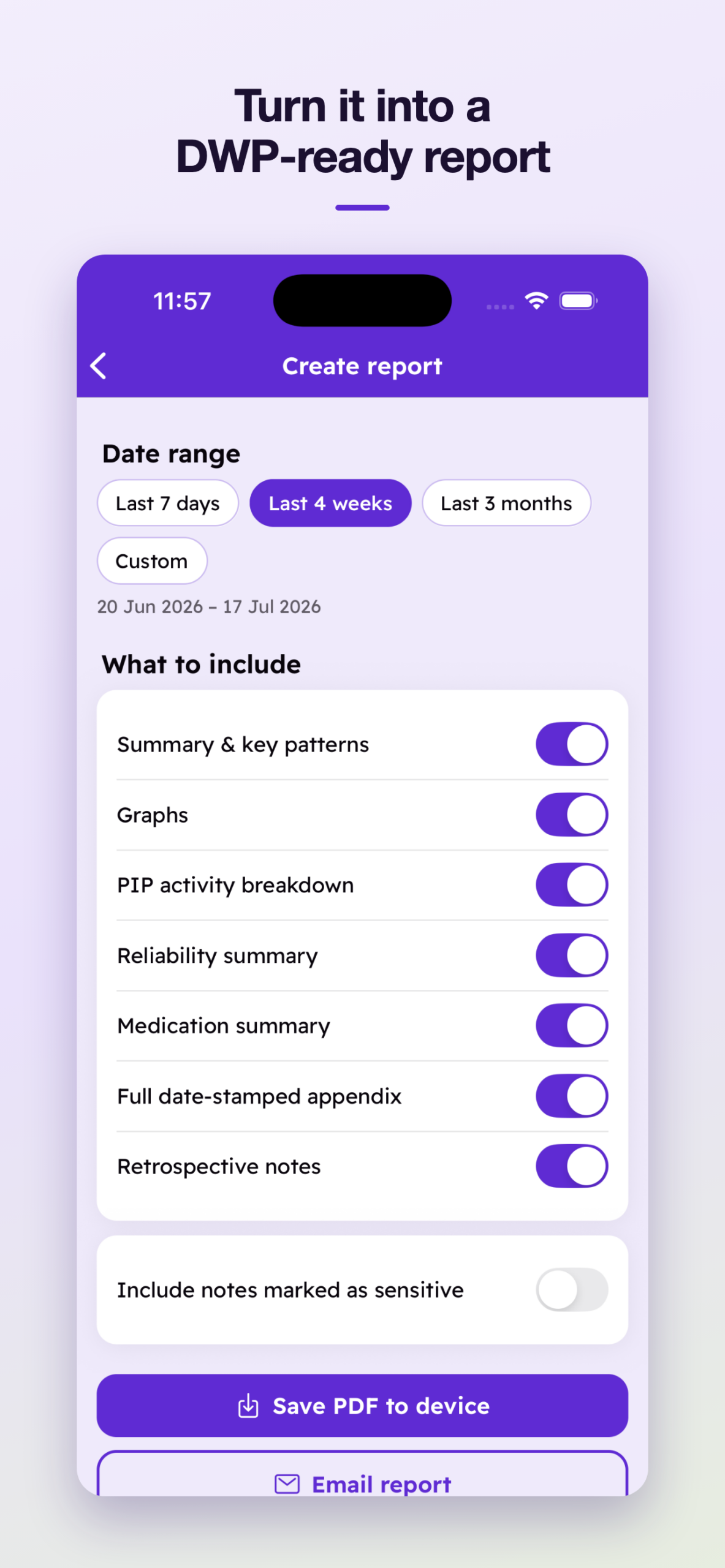
A tracker report brings the information you have already recorded into one place, rather than leaving you to work through weeks or months of separate diary entries.
“When my PIP reassessment happens, I have all of the information to hand.”
Annie, Purpl member
When sending information for a challenge or appeal, you can:
The report is supporting information. It does not prove that a decision is wrong or guarantee that an appeal will succeed.
Purpl Tip: Always read your report before sharing it and make sure it accurately reflects what you want DWP, Social Security Scotland or an adviser to see.
Yes.
The Purpl PIP Tracker includes medication tracking.
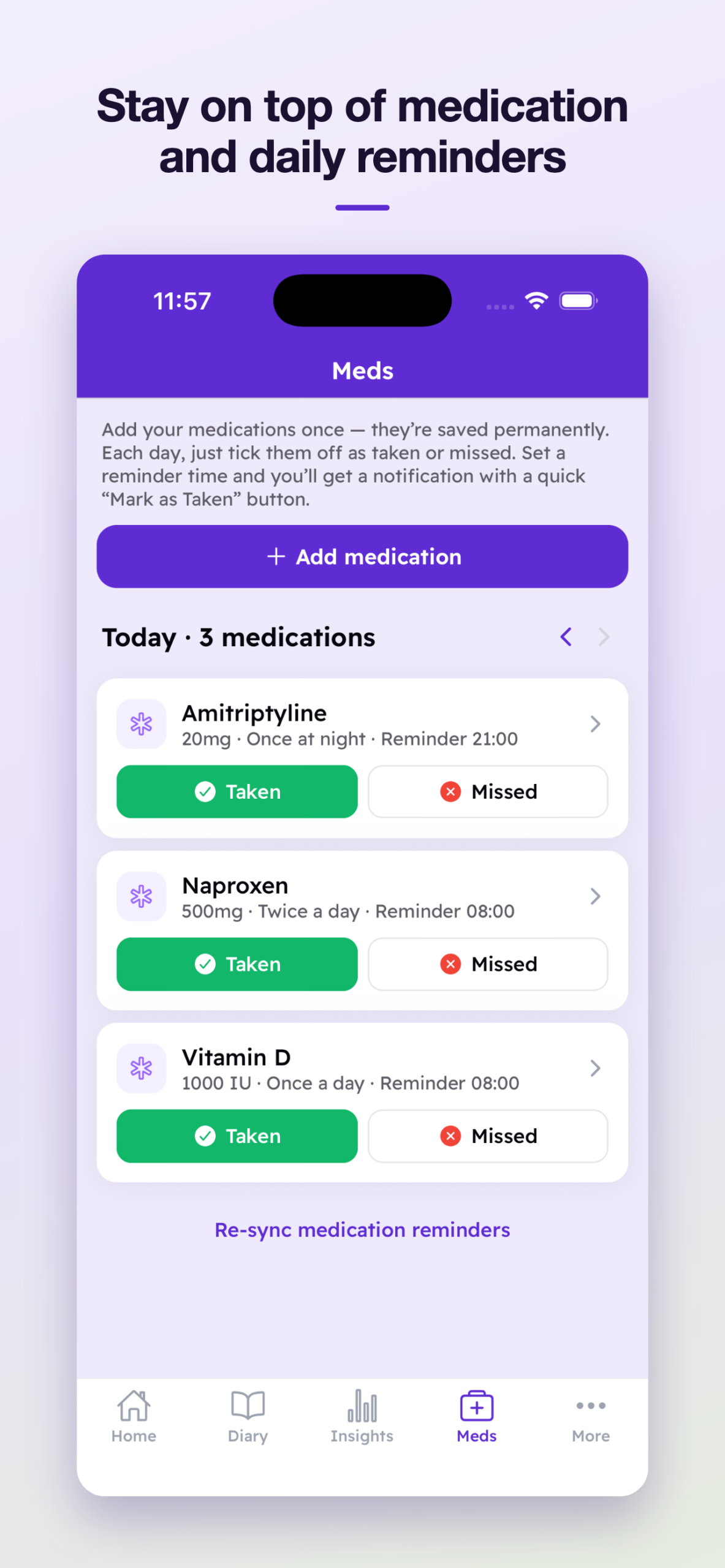
You can:
If side effects such as tiredness, nausea, dizziness or brain fog affect your everyday activities, you can record that impact in your daily diary too.
Purpl Insight: For PIP or ADP, the useful part is not simply the name of the medication. It is what your condition, treatment or side effects mean for your everyday life.
Your diary may contain very personal information about your health and daily life.
The Purpl PIP Tracker is designed so your diary records stay on your own device.
Purpl does not have access to your records or data used in the app.
Information is shared only when you choose to export or share it.
That means you stay in control of what goes into your diary and what, if anything, you send to someone else.
Purpl Insight: It is your diary and your information. You decide what you share.
We wanted the PIP Tracker to be genuinely useful in everyday life, not just something that looked good on paper.
So Purpl members were involved in shaping the final design and functionality of the tracker, including how much information people should be asked to enter, what should be optional, how the diary should handle wider daily impact and how useful the insights and reports felt in practice.
Members have also been using the tracker over a period of time and feeding back on what works well, what feels manageable on difficult days and what makes the app genuinely useful.
That feedback has helped reinforce some of the most important parts of the tracker, including:
What Purpl members are saying
I’ve been using the app for three weeks now. I love the ability to skip the parts I don’t want to fill in, and the free text entry allows me to diarise other things that affect my mood or cause more anxiety and stress.
This really is a ‘Swiss army knife’ of an app. The freedom to enter what I like or skip what I don’t need makes it fit, and I imagine for other disabled people they can choose to enter what they want and ignore what they don’t.
I find especially useful the ability to turn my data into a chart to see where I’ve been struggling and compare my diary entries to the days. It makes a big difference when you can see it in front of you.
James, Purpl member
This symptom tracker is a godsend, allowing me to log how I’m managing (or not) every day, like a diary, so that when my PIP reassessment happens, I have all of the information to hand and can complete the form without stress.
Why on earth has no one created anything like this sooner? Thank you, Purpl Discounts!
Annie, Purpl member
I’ve tried many trackers in the past, but they all focus on just one element. I’ve tried a food tracking app, a depression app and an anxiety app. I never seem to stick with them for long.
I am absolutely over the moon with your tracker. It combines all that I need, plus a lot more. To have it all on one app is so good.
Leading up to a hospital procedure, I could see how my thoughts, feelings, mobility and eating were. I noticed how much my pain affected my mood, eating, anxiety and ability to get things done. I was able to compare it to after the procedure, without having to try and remember exactly what I’d felt like.
I can check any day without having to try and remember. It’s like I’m writing my own journal, with everything I feel, my mobility and lots more on a particular day.
It has to be the best app I’ve ever used. I think this is the first app ever that I’ve wanted to use. 10 out of 10. Highly, highly recommended!
Claire, Purpl member. Edited for length.
Purpl Insight: We built the tracker around real feedback from disabled members using it in everyday life. That matters because the best way to know whether a disability tool actually works is to put it in the hands of the people it was designed for.
The Purpl PIP Tracker is a free digital daily symptom diary for people with disabilities and long term health conditions. It helps you record how your condition affects everyday activities and build a record that may be useful for PIP or Adult Disability Payment applications, reviews and appeals.
Yes. Although it is called the PIP Tracker, you can also use it for Adult Disability Payment. ADP uses the same 10 Daily Living activity areas and two Mobility activity areas, and Social Security Scotland applies the same four reliability questions when deciding which descriptor applies.
Adult Disability Payment has replaced PIP for new working-age disability benefit applications in Scotland. It is administered by Social Security Scotland rather than DWP. Like PIP, it has a Daily Living part and a Mobility part, and the amount you receive depends on how your condition affects everyday activities and getting around (mygov.scot).
It can. A diary helps you record examples, how often difficulties happen, what support you needed and how your condition changes. Citizens Advice says a diary can be useful evidence for PIP if your condition fluctuates and can also help you complete your form (Citizens Advice).
Useful information can include:
Yes. Both systems have rules for considering conditions where someone’s ability changes from day to day. Your diary can help you build a clearer record of those changes.
It means looking at whether you can complete an activity:
Both DWP and Social Security Scotland use these four reliability questions.
For PIP, DWP generally considers whether a scoring descriptor applies on more than 50% of days over the relevant 12-month period. ADP also has rules for deciding which descriptor applies where needs vary across different days. The Purpl PIP Tracker can help you record patterns, but it does not decide whether the legal test has been met.
No. The tracker does not calculate your entitlement, predict your award or guarantee that a particular descriptor will apply. It helps you organise your own experiences and supporting information.
Starting a diary early can mean you already have specific examples available when you complete your forms or discuss your needs. It cannot guarantee the decision you receive, but it can make it much easier to explain what has happened over time without relying on memory alone.
Yes. You can use it to keep examples ready for a PIP review or reassessment.
Yes. You can keep a record of how your condition affects you before or during an Adult Disability Payment review.
Yes. Your diary and report can help you organise examples when asking DWP to look at a PIP decision again.
Yes. Your diary can help you organise information if you ask Social Security Scotland to look at your ADP decision again.
Yes. You can use your diary entries and report when preparing for a PIP or ADP appeal or when talking to a welfare rights adviser or representative.
Someone can help you record your experiences if fatigue, pain, cognitive difficulties or another disability related barrier makes it difficult to complete the diary yourself. The information should still describe your experience.
Yes. You can keep medication details in the app and set reminders.
Yes. You can enable daily reminders to help you build a consistent record.
Yes. You can generate a report using the diary information you have recorded.
Yes. The app is completely free to download and use.
No. You only need a free Purpl account. You do not need a paid membership or disability verification.
Yes. The app is available free on the Apple App Store and Google Play.
Yes. Your diary stays on your device unless you choose to export or share information.
The free Purpl PIP Tracker gives you a simple way to record how your disability or long term health condition affects everyday life.
You can use it for:
The idea is simple. Instead of trying to remember months of difficult days when a form arrives, you build the record as you go.
The tracker helps you:
The tracker does not decide whether you qualify for PIP or ADP, calculate your points or guarantee an award.
It simply helps you keep a clearer record of your own experience, ready for whenever you need it.
Download the free Purpl PIP Tracker from the Apple App Store or Google Play, or visit piptracker.co.uk.
Georgina is the Founder of Purpl and a disability advocate with lived experience of disability.
She created Purpl to help people with disabilities and long term health conditions reduce the extra costs and barriers that come with disabled life.
Alongside disability discounts, Purpl creates practical guides, tools and community resources designed around the realities of living with a disability.
The Purpl PIP Tracker came from one message Georgina heard repeatedly:
“I wish I’d started keeping a diary sooner.”
So Purpl built one.
To get your free Purpl PIP Tracker please go our dedicated website – https://piptracker.co.uk/
If you’re using the PIP Tracker, these Purpl guides can help you understand what happens at different stages of the PIP process:
Purpl’s UK Disability Benefits & Support Handbook
A wider UK guide covering disability benefits, extra support, grants, concessions and other help that people with disabilities and long term health conditions may be able to access.
Step-by-step guide to preparing for a PIP assessment
What happens at a PIP assessment, how to prepare, what evidence to have ready and what the assessor may ask.
How are PIP points given? Understanding PIP descriptors and scoring for maximum benefits
A detailed guide to the PIP Daily Living and Mobility descriptors, points system, reliability rules and the types of real life examples to think about.
Are DWP health assessments now recorded automatically?
Find out how recording now works for PIP and other DWP health assessments, what happens if you opt out and when a recording could be useful.
Has your PIP award review date suddenly changed?
Understand the latest PIP review and reassessment changes and what they could mean for your award.
The Purpl PIP Tracker is designed to help you record your own experiences and organise information that may be useful during a PIP or Adult Disability Payment application, review or challenge. It does not calculate entitlement, guarantee an award or provide individual legal, medical or welfare rights advice.