
Download the app


© 2026. The Purpl Co Limited. All rights reserved.


Download the app
© 2026. The Purpl Co Limited. All rights reserved.
19 min read
Written by
Georgina Founder of Purpl and Carly Benefits Advisor
Published on
February 6, 2025
Personal Independence Payment (PIP) is a welfare benefit provided by the UK government to help people who have a long-term physical or mental health condition or disability. It is intended to help cover the extra costs associated with daily living or mobility issues caused by the condition. To be eligible for PIP you will be assessed and given a score, this score will determine the level of PIP you receive. This article was written to help you understand how are PIP points given as well as explaining the PIP descriptors and scoring process.
You can read our Guide to PIP that explains in more detail what PIP is, who is eligible and how to apply, plus the other benefits you could be entitled to if you claim PIP.
If you are unhappy with the decision on your PIP claim, you can also read our Guide to PIP reconsiderations and appeals here.
The information in this guide is correct as of February 2025. Purpl accepts no responsibility for the content of third-party websites and cannot guarantee that all these services mentioned may be able to help. Please note that situations and funding change from time to time. Purpl offer this information to be helpful and in good faith.
If you are thinking about applying for PIP then it’s good to understand how the PIP claim process work, to summarise you will need to go through these steps:
PIP is focused is on how your health condition affects your daily life and ability to perform everyday tasks, not simply the diagnosis of your condition itself.
Georgina’s Disability Money Saving Tips
To apply for PIP, you must have a health condition or disability that limits your ability to carry out daily activities or move around, and has lasted for at least 12 months.
PIP has two components and you will be assessed on both and given an overall score for each:
PIP Daily Living Component: This determines how much help you require for everyday activities like cooking, washing, dressing, or managing finances.
PIP Mobility Component: This determines how difficult it is for you to move around, as well as covering how difficult it is for you to plan or follow journeys.
Points are then awarded based on your ability to carry out specific activities within each of the components.
Each activity has a descriptor that describe different levels of difficulty, with points assigned accordingly. Points range from 0 (no difficulty) to 12 (severe difficulty) for each activity.
The number of PIP points you then receive for each component will determine whether you will receive the Standard Rate or the Enhanced Rate of payment for that component.
In order to be eligible for any payment you need to meet the minimum point criteria for either the standard rate or the enhanced rate. The points are based on how much your health condition impacts your day to day life.
As part of the overall PIP assessment you will receive a score for each PIP component and this will determine whether you will receive payment.
To be eligible for the Standard Rate of PIP Daily Living Component you will need to score at least 8 points.
To be eligible for the Enhanced Rate of PIP Daily Living Component you will need to score at least 12 points.
To be eligible for the Standard Rate of PIP Mobility Component you will need to score at least 8 points.
To be eligible for the Enhanced Rate of PIP Mobility Component you will need to score at least 12 points.
Please note that each component is assessed separately and the points are not added together.
The rate of PIP benefit payment you will then receive is based on how many points you score, this article goes through the full list of PIP points to help you understand how you may score.
The DWP will assess all your submitted documents as well as your assessment, they will use this information to decide what score you receive for each component:
You can use the interactive Turn2us PIP Helper to check what PIP award you are likely to get. You can also check what points you might score by looking at each of the activities in this guide.
Label all your medical evidence with your National Insurance number so it won’t get lost.
Georgina’s Disability Money Saving Tips
After you done the initial claim for PIP you will be sent a PIP2 booklet called ‘How Your Disability Affects You‘. In this booklet you will need to to assess how you condition impacts your day to day life for both the Daily Living Component and the Mobility Component.
To do this, the form is broken down into two sections, one for Daily Living and one for Mobility. Each sections covers a number of different topics. Each topic will have a list of standard statements that describe what you can or can’t do. These statements are known as ‘descriptors’.
Below is the list of topics and the PIP descriptors for the Daily Living Component of PIP:
| Preparing Food – Descriptors | No of Points |
|---|---|
| 1. Can prepare and cook a simple meal unaided | 0 points |
| 2. Needs to use an aid or appliance to be able to either prepare or cook a simple meal | 2 points |
| 3. Cannot cook a simple meal using a conventional cooker but is able to do so using a microwave | 2 points |
| 4. Needs prompting to be able to either prepare or cook a simple meal | 2 points |
| 5. Needs supervision or assistance to either prepare or cook a simple meal | 4 points |
| 6. Cannot prepare and cook food | 8 points |
| Taking Nutrition – Descriptors | No of Points |
|---|---|
| 1. Can take nutrition unaided | 0 point |
| 2. Needs to use an aid or appliance to be able to take nutrition; or supervision to be able to take nutrition; or assistance to be able to cut up food | 2 points |
| 3. Needs a therapeutic source to be able to take nutrition | 2 points |
| 4. Needs prompting to be able to take nutrition | 4 points |
| 5. Needs assistance to be able to manage a therapeutic source to take nutrition | 6 points |
| 6. Cannot convey food and drink to their mouth and needs another person to do so | 10 points |
| Managing Therapy or Monitoring a Health Condition – Descriptors | No of Points |
|---|---|
| 1. Either does not receive medication or therapy or need to monitor a health condition; or can manage medication or therapy or monitor a health condition unaided. | 0 points |
| 2. Needs to use an aid or appliance to be able to manage medication; or needs supervision, prompting or assistance to be able to manage medication; or needs supervision, prompting or assistance to be able to monitor a health condition. | 1 point |
| 3. Needs supervision, prompting or assistance to be able to manage therapy that takes no more than 3.5 hours a week | 2 points |
| 4. Needs supervision, prompting or assistance to be able to manage therapy that takes more than 3.5 but no more than 7 hours a week | 4 points |
| 5. Needs supervision, prompting or assistance to be able to manage therapy that takes more than 7 but no more than 14 hours a week | 6 points |
| 6. Needs supervision, prompting or assistance to be able to manage therapy that takes more than 14 hours a week | 8 points |
| Washing and Bathing – Descriptors | No of Points |
|---|---|
| 1. Can wash and bathe unaided | 0 points |
| 2. Needs to use an aid or appliance to be able to wash or bathe | 2 points |
| 3. Needs supervision or prompting to be able to wash or bathe | 2 points |
| 4. Needs assistance to be able to wash either their hair or body below the waist. | 2 points |
| 5. Needs assistance to be able to get in or out of a bath or shower | 3 points |
| 6. Needs assistance to be able to wash their body between the shoulders and waist | 4 points |
| 7. Cannot wash and bathe at all and needs another person to wash their entire body | 8 points |
| Managing Toilet Needs or Incontinence – Descriptors | No of Points |
|---|---|
| 1. Can manage toilet needs or incontinence unaided. | 0 points |
| 2. Needs to use an aid or appliance to be able to manage toilet needs or incontinence | 2 points |
| 3. Needs supervision or prompting to be able to manage toilet needs | 2 points |
| 4. Needs assistance to be able to manage toilet needs | 4 points |
| 5. Needs assistance to be able to manage incontinence of either bladder or bowel | 6 points |
| 6. Needs assistance to be able to manage incontinence of both bladder and bowel | 8 points |
| Dressing and Undressing – Descriptors | No of Points |
|---|---|
| 1. Can dress and undress unaided | 0 points |
| 2. Needs to use an aid or appliance to be able to dress or undress | 2 points |
| 3. Needs either prompting to be able to dress, undress or determine appropriate circumstances for remaining clothed; or prompting or assistance to be able to select appropriate clothing | 2 points |
| 4. Needs assistance to be able to dress or undress their lower body | 2 points |
| 5. Needs assistance to be able to dress or undress their upper body | 4 points |
| 6. Cannot dress or undress at all | 8 points |
| Communicating Verbally – Descriptors | No of Points |
|---|---|
| 1. Can express and understand verbal information unaided | 0 points |
| 2. Needs to use an aid or appliance to be able to speak or hear | 2 points |
| 3. Needs communication support to be able to express or understand complex verbal information | 4 points |
| 4. Needs communication support to be able to express or understand basic verbal information | 8 points |
| 5. Cannot express or understand verbal information at all even with communication support | 12 points |
| Reading and Understanding Signs, Symbols and Words – Descriptors | No of Points |
|---|---|
| 1. Can read and understand basic and complex written information either unaided or using spectacles or contact lenses | 0 points |
| 2. Needs to use an aid or appliance, other than spectacles or contact lenses, to be able to read or understand either basic or complex written information | 2 points |
| 3. Needs prompting to be able to read or understand complex written information | 2 points |
| 4. Needs prompting to be able to read or understand basic written information | 4 points |
| 5. Cannot read or understand signs, symbols or words at all | 8 points |
| Engaging with Other People Face to Face – Descriptors | No of Points |
|---|---|
| 1. Can engage with other people unaided | 0 points |
| 2. Needs prompting to be able to engage with other people | 2 points |
| 3. Needs social support to be able to engage with other people | 4 points |
| 4. Needs prompting to be able to read or understand basic written information | 4 points |
| 5. Cannot engage with other people due to such engagement causing either – overwhelming psychological distress to the claimant; or the claimant to exhibit behaviour which would result in a substantial risk of harm to the claimant or another person | 8 points |
| Making Budgeting Decisions – Descriptors | No of Points |
|---|---|
| 1. Can manage complex budgeting decisions unaided. 0 points. | 0 points |
| 2. Needs prompting or assistance to be able to make complex budgeting decisions | 2 points |
| 3. Needs prompting or assistance to be able to make simple budgeting decisions | 4 points |
| 4. Cannot make any budgeting decisions at all | 6 points |
Keep a diary as evidence of how you’re affected day-to-day. This is especially important if you have a fluctuating condition!
Georgina’s Disability Tips
Below is the list of topics and the PIP descriptors for the Mobility Component of PIP:
| Planning and Following Journeys – Descriptors | No of Points |
|---|---|
| 1. Can plan and follow the route of a journey unaided | 0 points |
| 2. Needs prompting to be able to undertake any journey to avoid overwhelming psychological distress to the claimant | 4 points |
| 3. Cannot plan the route of a journey | 8 points |
| 4. Cannot follow the route of an unfamiliar journey without another person, assistance dog or orientation aid | 10 points |
| 5. Cannot undertake any journey because it would cause overwhelming psychological distress to the claimant | 10 points |
| 6. Cannot follow the route of a familiar journey without another person, an assistance dog or an orientation aid | 12 points |
| Moving Around – Descriptors | No of Points |
|---|---|
| 1. Can stand and then move more than 200 metres, either aided or unaided | 0 points |
| 2. Can stand and then move more than 50 metres but no more than 200 metres, either aided or unaided | 4 points |
| 3. Can stand and then move unaided more than 20 metres but no more than 50 metres | 8 points |
| 4. Can stand and then move using an aid or appliance more than 20 metres but no more than 50 metres | 10 points |
| 5. Can stand and then move more than 1 metre but no more than 20 metres, either aided or unaided | 12 points |
| 6. Cannot, either aided or unaided, stand or move more than 1 metre | 12 points |
PIP considers how your condition affects you on the majority of days (more than 50% of the time) so if your condition fluctuates, think about it over a longer period of time. If your condition varies, explain bad days vs. good days and how often each occurs
Georgina’s Disability Tip
When applying for PIP or appealing a decision, gathering strong supporting evidence is essential to back up your claim and demonstrate how your condition affects your daily life. The more detailed and varied your supporting evidence is, the stronger your case will be, increasing the likelihood of receiving the correct award. The DWP does not automatically request your medical records, so it’s your responsibility to submit relevant documentation and evidence that supports your case.
Medical evidence is a really important part of your claim because it shows how you really are affected by the health conditions or disabilities you reported, though you don’t need a diagnosis to be able to apply for PIP, you do need to be able to give evidence that you are experiencing the symptoms that are affecting your ability to manage daily living or mobility activities.
Some examples of good information to include are:
Keep a Dairy
Keeping a diary of symptoms and daily challenges is another effective way to show how your condition impacts you over time, this can be particularly useful for fluctuating conditions.
When submitting evidence, ensure it is specific and relevant to the PIP descriptors, highlighting the difficulties you face in performing tasks safely, repeatedly, and in a reasonable timeframe.
Turn2Us have created a diary template you can download and fill out. They say a diary can be helpful evidence of how often you’re affected and what help you need.
Letters from People Who Know You
Letters from carers, family members, or support workers can be extremely valuable, as they can describe the help you need on a daily basis from someone who sees your struggles firsthand.
If someone is writing a letter for you, ask them to include the date, their full name and address, and their signature and ask them to focus on the PIP activities and how your condition affects your ability to do these activities.
Use Real Life Examples
When applying for or appealing a PIP decision, it’s crucial to describe how each activity affects you in daily life, providing detailed real-life examples. Don’t just state that you struggle with a task—explain why and what happens when you attempt it.
For example, if you have difficulty dressing, describe whether this is due to pain, stiffness, fatigue, or another factor, and specify which parts of the task you struggle with.
Instead of saying: “I have trouble getting dressed,” a stronger example would be:
“Due to severe arthritis in my hands, I struggle to grip small objects like buttons and zippers, making it impossible to fasten my clothes without assistance. On bad days, I experience intense pain and swelling, which means I need someone to physically help me put on a jumper or shoes.”
Similarly, if fatigue is a factor, you might explain: “My condition causes extreme exhaustion, and even lifting my arms to put on a shirt leaves me feeling drained. If I attempt to get dressed without help, I need to rest for at least 20 minutes afterward.”
If safety is an issue, describe any risks involved, such as falls, dizziness, or injury. By giving clear, specific details and explaining how often this happens, you can provide stronger evidence for why you meet the descriptor criteria.
What does this ‘Reliably, in a Timely Fashion, Repeatedly and Safely‘ mean? This term questions whether you are able to complete each activity descriptor reliably, in a timely fashion, repeatedly and safely; and where indicated, whether you can do it using aids and appliances or with support from another person (or a support dog). If you can’t then you would be considered ‘unable to complete the activity described at that level’
Reliably means to a reasonable standard.
In a timely fashion means it should take the individual less than twice the time it would take for a non-disabled person.
Repeatedly means that the individual can complete the action often throughout the day as the activity requires. But it should be considered whether the action of doing so impacts symptoms such as; pain and fatigue, when completing the activity repeatedly.
Safely means in a fashion that is unlikely to cause harm to the individual, either directly or through vulnerability to the actions of others; or to another person.
The PIP assessment will take notice of any aids and appliances that you may use. The definition of these words are:
Aids: devices that help a performance of a function, for example, walking sticks or spectacles.
Appliances: devices that provide or replace a missing function, for example artificial limbs, collecting devices (stomas) and wheelchairs.
People who use aids or appliances to carry out an activity will generally receive a higher scoring descriptor than those who can carry out the activity unaided. If you use a number of aids and appliances make sure you detail this on the form.
Your PIP assessment will take into account whether you need the support of another person to carry out an activity – including where that person has to carry out the activity for you in its entirety. The criteria refers to three types of support:
Assistance: support that requires the presence of another person. To apply, this only needs to be required for part of the activity.
Prompting: support provided by another person in reminding or encouraging you to undertake or complete a task but not physically helping you.
Supervision: need for the continuous presence of another person to avoid a serious harm or risk to yourself. To apply, this must be required for the full duration of the activity.
Unaided: the ability to perform an activity ‘unaided’ means without either the use of aids or appliances or assistance/prompting/supervision from another person.
Don’t send originals of your medical evidence. If you or a friend or family member don’t have a printer, libraries will usually have a photocopier you can use.
Georgina’s Disability Tips
Turn2Us’s Find an Adviser Tool: allows you to search for local, regional, or national organisations that can provide you with information and advice on benefits and more.
Citizens Advice: offers free and independent advice.
Purpl Life: a range of articles to help you understand disability benefits and support available
Benefits and Work: offer a lot of information on PIP and other benefits.
Purpl Private Facebook Group: support from members of the Purpl disabled community.
The benefits system can feel overwhelming, stressful and difficult, especially when you are already dealing with your own condition and how it affects you. Don’t be afraid to ask for help, it is out there and we all need some support from time to time!
Georgina’s Disability Tips
Our Purpl member, Carly, has been a voluntary benefits advisor since 2017 and she sent us this guide to give examples of some of the questions you should consider about yourself in order to answer the application questions for PIP.
You should also list any holistic/alternative therapies you have had up to the time of applying for PIP and any you are waiting to start.
You can include ones you pay for like chiropractor, massage, podiatry, herbalist, naturopath. Detail what they cost, how often you have sessions, and what symptoms they help with. It helps to include where you go for the sessions, and who you see.
Give details of professionals that have a good understanding of your health conditions and/or disabilities. If you have more than three you see on a regular basis, put these on a separate sheet of paper with your form. (add your name and national insurance number at the top)
Do you have any conditions/disabilities that affect your ability to communicate? What are they?
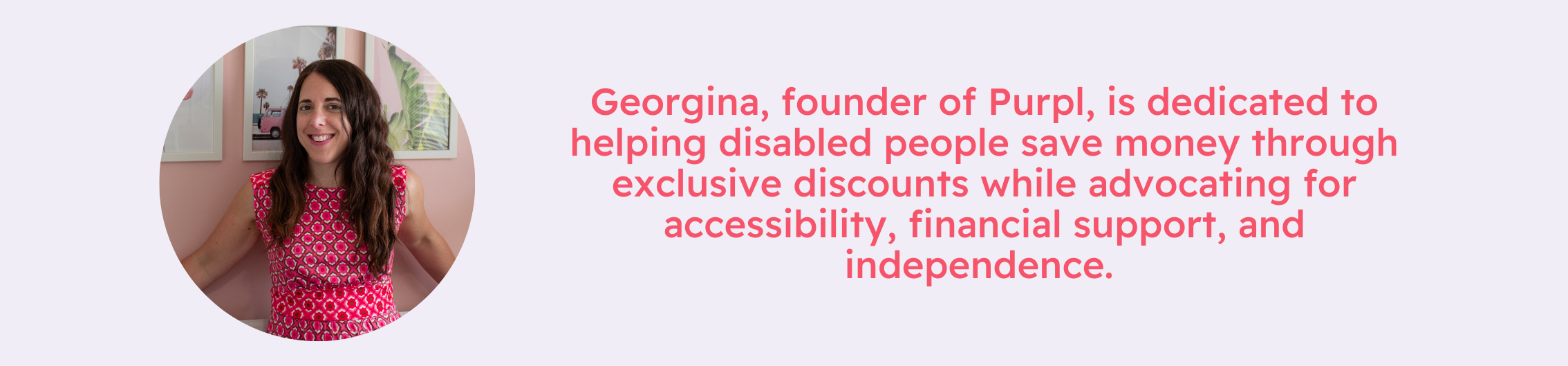
Georgina is the founder of Purpl, a platform dedicated to helping disabled people save money through exclusive discounts. Living with Multiple Sclerosis (MS) and ADHD, she understands firsthand the financial challenges of living with a disability. Her mission is to work with brands to secure discounts that ease the cost of essential products, services, and everyday expenses for the disabled community.
As an ambulatory wheelchair user, Georgina knows how it feels to lose independence due to a disability. She is passionate about holistic therapies and diet to manage inflammation and stay as healthy as possible. Her goal is to make Purpl an essential resource for disabled people, offering practical support, advice, and financial relief.
Beyond Purpl, Georgina has a long-term vision to launch a foundation providing grants for disabled people who need extra financial support.
You can read her story about why she launched Purpl and her ultimate goal of launching a foundation to give grants to disabled people in the UK.
Follow @Purpldiscounts for the latest disability discounts, financial advice, and accessibility resources.
Carly runs the voluntary advice line at Kasbah, who were originally partnered with DIAL but the service is now run as part of the charity and services it offers. She does face to face and telephone appointments supporting people on filling in forms for things such as PIP, Universal Credit, Work Capability, DLA for adults and children and Attendance Allowance.She also assist with reviews of benefits and appeals, advocates for people with things such as housing issues , mental health, support with appointment making. Carly has shared her expertise with Purpl as a volunteer and we are incredibly grateful to her for her help and support with this article.
How to Save Money if you Live with a Disability in the UK
How to Apply for PIP and Maximise the Benefits in the UK
Understanding Attendance Allowance – Disability Benefit for Disabled People Over 65
If you are not currently a member of Purpl, please consider registering with us today to get access to even more information and exclusive discounts from hundreds of brands! Read our guide on How to Join Purpl.