
Download the app


© 2026. The Purpl Co Limited. All rights reserved.


Download the app
© 2026. The Purpl Co Limited. All rights reserved.
13 min read
Written by
Georgina, Founder of Purpl
Published on
July 23, 2026
Last reviewed: 23 July 2026
Applies to: UK
Written by: Georgina, Founder of Purpl
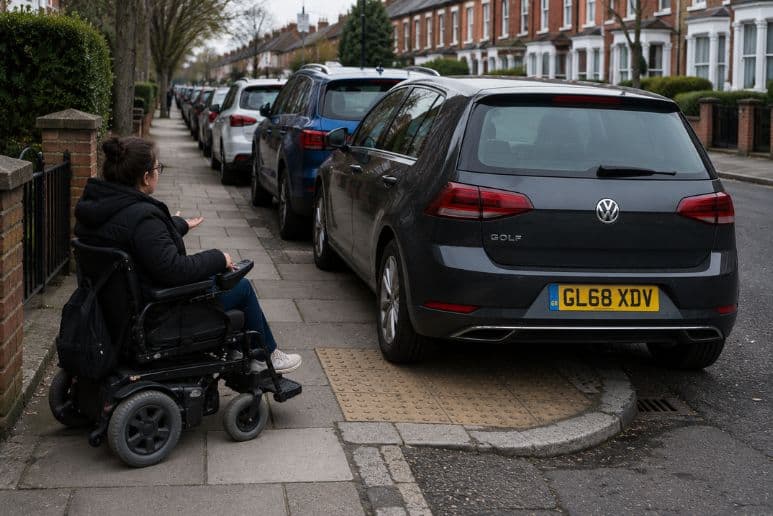
Pavement parking is illegal across London and Scotland, but there is still no nationwide ban in England. The UK Government has announced new powers that will allow councils in England to enforce against unnecessary pavement obstruction and introduce restrictions across wider areas. However, local authorities will decide where and how those powers are used.
For wheelchair users, mobility scooter riders, blind and partially sighted people, parents with pushchairs and anyone using a walking aid, this still creates a postcode lottery.
A vehicle blocking the pavement is not simply inconvenient. It can force someone into moving traffic, make them turn back or prevent them from leaving home safely.
Our own Purpl community polls show the scale of the problem. Nearly six in ten respondents said they had moved into the road because a vehicle was blocking the pavement, while almost one in ten had needed to ask someone else for help.
At Purpl, we believe accessible streets are as important as accessible buildings. Disabled people should be able to travel safely and independently without their freedom depending on where they live.
Join Purpl from £1 a month to access verified disability discounts on everyday essentials, mobility products, travel, household bills and more.
There is no single UK-wide pavement parking law.
The rules differ across England, Scotland, Wales and Northern Ireland. They may also vary between local authority areas.
Yes, unless signs specifically permit it.
Parking with one or more wheels on the pavement has generally been prohibited across Greater London since 1974. London councils can issue a Penalty Charge Notice when a vehicle is parked wholly or partly on a footpath or another part of the road that is not the carriageway.
The restriction covers London’s boroughs and the City of London, although individual streets can have signed exemptions. Current contravention information is available through London Councils.
Yes, although specific exemptions may apply.
The Transport (Scotland) Act 2019 introduced national prohibitions covering:
Scottish councils were able to begin enforcing the rules from 11 December 2023. A Penalty Charge Notice can be set at up to £100 and is normally reduced by 50% when paid within 14 days.
Local authorities can exempt limited stretches of pavement where strict conditions are met, but the starting point is that pavement parking is prohibited. The rules are explained by Transport Scotland.
Not automatically.
England still has no blanket national ban outside London.
Parking on a pavement may already be dealt with where there are parking restrictions, where a specific Traffic Regulation Order applies or where the vehicle causes an obstruction. However, councils have historically faced a slow and complicated process when introducing wider pavement parking restrictions.
In January 2026, the Government confirmed that councils with designated civil enforcement powers would be allowed to enforce against unnecessary obstruction of the pavement.
The Government is also making it easier for strategic authorities, county councils and unitary authorities to introduce restrictions across wider areas rather than dealing with one street at a time. The full approach is set out in the Government’s response to the pavement parking consultation.
Driving onto a footway without lawful authority has long been restricted under Section 72 of the Highways Act 1835.
However, enforcing the act of driving onto the pavement is not the same as having a clear nationwide ban on leaving a vehicle parked there. This distinction is one reason the law has remained confusing for drivers and difficult to enforce consistently.
There is no country-wide blanket ban.
Welsh councils can enforce existing parking restrictions, including restrictions around dropped kerbs and marked areas. However, Wales has not introduced the same national prohibition as Scotland.
The Welsh Government has previously examined options for improving pavement parking enforcement through its Pavement Parking Task Force.
There is no general blanket ban.
Traffic attendants enforce restrictions such as yellow lines and other designated parking controls. Dangerous parking and vehicles causing an obstruction remain the responsibility of the Police Service of Northern Ireland.
Nidirect’s parking enforcement guidance confirms that the PSNI is responsible for dangerous parking and parking that causes an obstruction.
The Government has chosen to give councils stronger local powers instead of introducing an immediate nationwide ban.
The changes are intended to allow councils to:
This should make it easier for councils to act in places where parked vehicles regularly block pavements.
The Government says local decision-making will allow authorities to consider the design of their roads, housing and parking provision. It also plans to issue guidance to support consistent enforcement.
Giving councils stronger powers is a positive step, but it does not guarantee clear pavements.
Each local authority will still decide whether pavement parking is a priority, which areas should be restricted and how actively the rules should be enforced.
That means disabled people may continue to experience very different levels of access in neighbouring towns.
One council may introduce area-wide restrictions and regular enforcement. Another may take little action because of limited funding, competing priorities or concerns about local parking capacity.
The Government’s own consultation found that 41% of individual respondents said they would leave home more often if pavement parking were addressed. Despite this, it chose local enforcement rather than the consultation option of a national prohibition with local exemptions.
A national ban with carefully managed exemptions would reverse the current position. Pavement parking would be prohibited by default, while councils could permit it only on streets where enough space remained for people to pass safely.
Pavement parking can remove a disabled person’s ability to travel independently.
A blocked pavement may force someone to:
The risk is particularly serious for:
Living Streets says vehicles parked on pavements can force people into the road and particularly affect wheelchair users, people with sight loss, parents with pushchairs and people using mobility aids. Guide Dogs’ Streets Ahead campaign similarly identifies pavement parking as a major barrier for people with visual impairments.
A pavement may look passable to a driver but still be inaccessible.
Wheelchairs and mobility scooters need enough width to pass without tipping off the kerb or scraping against the vehicle. Guide dog owners need space to navigate around an obstruction safely. Someone using crutches or a rollator may not be able to squeeze through a narrow gap or step into the road.
Dropped kerbs are equally important. Parking across the only accessible crossing point can leave a wheelchair user trapped on one side of the road.
We asked members of the members only Facebook group, how pavement parking affects them.
These were informal, self-selecting Facebook polls rather than nationally representative research. The findings should therefore be understood as a snapshot of the experiences shared within our community.
Even with that limitation, the results show how often disabled people are placed in unsafe and unacceptable situations.
We asked wheelchair and mobility aid users:
How often does pavement parking prevent you from getting past safely?
Respondents told us:
Combined, 95% said pavement parking prevents them from getting past safely very often or sometimes.
Only 1% said it had never affected them.
This is not an occasional inconvenience for our community. For many members, it is a regular barrier whenever they leave home.
We then asked:
What have you had to do because a vehicle was blocking the pavement?
The results were:
That means 98% of respondents had been forced to take some form of action because a vehicle was blocking the pavement.
Most concerningly, three in five said they had moved into the road.
The comments beneath our polls revealed the real impact behind those percentages.
Purpl members described:
One member described having to travel around 40 minutes out of their way because a car was parked across the only dropped kerb they could use.
Another said that driving into the road and facing oncoming vehicles can make mobility scooter users feel trapped indoors on days when they do not have the confidence to take the risk.
Members also highlighted that parked cars are only one part of the problem. A lack of dropped kerbs, cracked pavements, bins and other street clutter can combine to make an entire route inaccessible.
What our research shows
Pavement parking does not merely make journeys less convenient.
It changes routes, delays appointments and forces disabled people into traffic. In some cases, it determines whether someone feels safe enough to leave home at all.
When almost six in ten respondents say they have moved into the road, this becomes a serious safety and equality issue.
Disability and walking organisations argue that a clear national rule would be easier for everyone to understand.
Living Streets supports a default ban with carefully considered local exemptions. It argues that vehicles parked on pavements endanger wheelchair users, people with visual impairments, families with pushchairs and others who need clear footways.
Guide Dogs welcomed the announcement of stronger council powers but continues campaigning for streets and public spaces that people with sight loss can navigate safely. Its research has also found strong support among councillors for action against pavement parking.
A national prohibition could:
Pavement parking can also damage paving stones, kerbs and underground infrastructure. Broken or uneven surfaces then create further hazards for wheelchair users, people with sight loss and anyone at risk of falling.
We often talk about accessible workplaces, public transport and healthcare.
People still need to reach them.
An accessible office is little use if a wheelchair user cannot travel safely along the pavement outside.
An accessible bus does not solve the problem when someone cannot reach the stop.
A hospital appointment cannot improve someone’s health if blocked pavements make the journey impossible.
Safe streets affect:
Pavement parking can also increase reliance on other people. Someone who could otherwise travel alone may need a friend, relative or carer simply to help them negotiate blocked routes.
Removing these barriers is part of preventing isolation, ill health and lost independence.
Most people who park on a pavement are not deliberately trying to make life difficult for disabled people.
In many cases, they are trying to keep the road clear for traffic, buses or emergency vehicles. The problem is that they may never have experienced what it is like to navigate the world using a wheelchair, mobility scooter, rollator or pushchair.
Georgina Colman, Founder of Purpl, says:
“I’ve seen both sides. Before I lost my ability to walk independently, I genuinely thought parking partly on the pavement was helping to keep the road clear for ambulances and other vehicles. I never stopped to think about wheelchair users, people with pushchairs or someone using a mobility scooter.
It wasn’t because I didn’t care. I simply hadn’t realised the impact it could have on somebody else’s ability to get where they needed to go. I think many drivers are the same.
That’s why education is just as important as enforcement. If we taught the impact of pavement parking as part of the Highway Code and driving lessons, future drivers would understand that pavements are essential for people’s independence, not just somewhere cars can overflow onto.”
The correct route depends on where you live and whether the vehicle is breaking a parking restriction or causing a dangerous obstruction.
Contact your council where:
Many councils provide an online reporting form.
Include:
Avoid placing yourself in danger while taking photographs.
Contact the police through 101 or your local force’s online reporting service where a vehicle is causing a serious or dangerous obstruction.
This may include situations where:
Call 999 only where there is an immediate danger to life or an emergency is taking place.
In Northern Ireland, dangerous parking and obstruction remain the responsibility of the PSNI.
A single report may deal with one vehicle, but repeated evidence can help councils identify a wider problem.
Keep a record of:
You can also contact your councillor, MP, MS, MSP or MLA and explain how the problem affects disabled people locally.
Living Streets and Guide Dogs both run national campaigns focused on safer and more accessible streets.
You can support their work, write to elected representatives or respond to relevant government and council consultations.
Inaccessible streets are one of many additional barriers disabled people face.
Living with a disability or long-term health condition can also mean paying more for energy, transport, mobility equipment, care, accessible travel and everyday essentials. These added costs are often described as the disability price tag.
Purpl helps eligible disabled people, people with long-term health conditions and carers reduce those costs through verified discounts on:
Purpl also puts 20% of eligible brand media spend into our Community Grant Fund, helping members with disability-related equipment and costs.
Explore Purpl’s disability discounts or join from £1 a month to start saving.
Pavement parking is generally prohibited across London unless signs permit it. Outside London, England does not have a blanket nationwide ban. Councils can enforce existing restrictions and are being given stronger powers to penalise unnecessary pavement obstruction and introduce wider local restrictions.
The Government is enabling councils with civil enforcement powers to act against unnecessary pavement obstruction. Strategic authorities, county councils and unitary authorities will also be able to introduce pavement parking restrictions across wider areas rather than relying only on street-by-street measures.
The Government announced the approach in January 2026 and said secondary legislation and supporting guidance would follow. Individual implementation will depend on the legislation taking effect and on decisions made by each eligible local authority.
Yes. Scotland has national prohibitions covering pavement parking, double parking and parking at dropped kerbs. Limited exemptions may apply on specified streets. Councils can issue a penalty of up to £100, normally reduced by half when paid within 14 days.
Wales does not currently have a Scotland-style nationwide ban. Councils can enforce existing parking restrictions, while the Welsh Government has previously examined wider options for dealing with pavement parking.
There is no general blanket prohibition. Traffic attendants enforce marked parking restrictions, while dangerous parking and vehicles causing an obstruction are dealt with by the PSNI.
A Blue Badge does not give its holder a general right to park on the pavement or cause an obstruction. Badge holders must follow local rules and should never park where their vehicle would place pedestrians at risk.
Parking across a dropped kerb may be enforceable, particularly where the crossing point helps pedestrians, wheelchair users or vehicles enter and leave a property. Scotland’s national rules specifically prohibit parking at dropped kerbs, subject to exemptions.
Do not put yourself at risk. Record the location and registration if it is safe to do so. Report parking contraventions to the council and serious or dangerous obstruction to the police through 101 or the force’s online reporting service.
Yes. A council may act where parking restrictions apply. The police may be responsible where the vehicle creates a dangerous or unnecessary obstruction. Include photographs and explain that the obstruction forces pedestrians or wheelchair users into moving traffic.
Pavement parking can prevent disabled people from travelling independently. It may block wheelchairs and mobility scooters, remove safe routes for blind people and guide dog owners, obstruct dropped kerbs and force pedestrians into the road.
Drivers should not assume that leaving a narrow gap makes pavement parking acceptable. Different users need different amounts of space, and wheelchairs, mobility scooters and guide dog partnerships may need substantially more room than a person walking alone. Drivers should follow the law and leave the whole pavement unobstructed unless clearly marked parking arrangements permit otherwise.
A nationwide default ban would make the rules clearer and more consistent. Local exemptions could still be created where pavement parking is genuinely necessary and enough unobstructed space remains for pedestrians.
The Government’s decision to give English councils stronger pavement parking powers is welcome.
It still does not provide the certainty of a nationwide ban.
Local authorities will decide whether to introduce restrictions, where they should apply and how strongly they will be enforced. Disabled people could therefore continue to face accessible streets in one area and dangerous obstruction in the next.
Purpl’s community research shows the consequences clearly:
These are not minor inconveniences.
They are barriers that restrict independence, delay essential journeys and expose disabled people to avoidable danger.
Accessible streets should never depend on your postcode.
Better enforcement will help, but so will better awareness. If every driver stopped for a moment and asked themselves, “Could somebody using a wheelchair, mobility scooter, walking aid or pushchair get past safely?” many of these situations could be avoided before they happen.
Georgina is the Founder of Purpl, a specialist UK discount platform built to help disabled people, people with long term health conditions and carers reduce the extra costs of daily life. Living with Multiple Sclerosis herself, Georgina uses lived experience to create practical, honest and jargon free guidance for the disabled community.
How to apply for a disabled parking space: https://www.purpldiscounts.com/blog/apply-for-disabled-parking-space
Explore Purpl mobility discounts: https://www.purpldiscounts.com/category/disability-aids
How the Purpl Community Grant Fund supports independent living: https://www.purpldiscounts.com/blog/purpl-community-grant-fund
Join the Purpl community: start saving on everyday essentials: https://www.purpldiscounts.com