
Download the app


© 2026. The Purpl Co Limited. All rights reserved.


Download the app
© 2026. The Purpl Co Limited. All rights reserved.
17 min read
Written by
Georgina, Founder of Purpl
Published on
November 24, 2026
Last reviewed: 24 November 2026
Applies to: England and Wales
Written by: Georgina, Founder of Purpl | Disabled & Neurodivergent Advocate
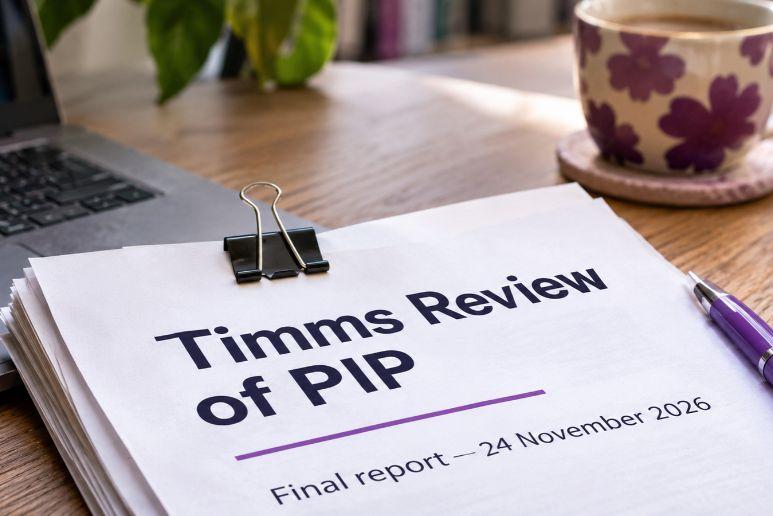
The final Timms Review of Personal Independence Payment (PIP) was published on 24 November 2026, setting out recommendations that could fundamentally change how disabled people access financial support.
The Government has already accepted two key recommendations: introducing a fast-track route for people with severe, well-evidenced conditions and reducing unnecessary award reviews for people whose conditions are unlikely to improve.
For those of us who receive PIP, there’s a lot to digest. Having spent years navigating a system that doesn’t always understand the realities of living with a disability, it’s encouraging to see so many of the issues our community regularly raises finally being acknowledged.
At Purpl, we welcome the move towards a system that better recognises individual needs, the true cost of disability and the importance of independent living. But there are still some big questions, particularly around funding, future eligibility and what happens to those of us who already rely on PIP.
Before we get into the detail, it’s important to remember that today’s announcement does not automatically change your existing PIP award or payments.
The Timms Review is the first comprehensive review of Personal Independence Payment since its introduction in 2013. Its final report, Making PIP fit for purpose: A new vision, draws on evidence from more than 40,000 people and organisations, including disabled people, carers, healthcare professionals and disability organisations.
The findings will probably come as little surprise to anyone who has struggled with the PIP process.
Of the 38,713 responses to the call for evidence:
Perhaps the most telling finding is that more than 90% of responses relating to the claiming process described it negatively, with people reporting experiences of stress, complexity and feeling dehumanised.
While these figures reflect the experiences of those who chose to respond rather than a representative sample of all PIP claimants, they help explain why trust in the system has become such an issue.
The full Timms Review final report reaches a clear conclusion: PIP provides essential financial support, but the system through which people access it is no longer fit for purpose.
The steering group recognises that we cannot simply wait for an entirely new benefit to be developed. It sets out improvements that could be made to the existing system alongside a longer-term vision for reform.
Purpl Insight: A benefit designed to reduce the barriers disabled people face shouldn’t create so many additional barriers of its own.
In its official response to the Timms Review, published on 24 November 2026, the Government accepted two key recommendations: introducing a fast-track route for people with severe conditions and reducing unnecessary award reviews.
These commitments could make a real difference to people’s experiences of claiming PIP, although the Government still needs to confirm exactly how and when the changes will happen.
The review proposes two fast-track pathways where eligible people could receive a PIP award without undergoing a full assessment:
For someone who already has extensive medical evidence demonstrating the impact of their disability, having to undergo a lengthy assessment can feel unnecessary. A simpler route could reduce that burden and help people access financial support more quickly.
The Government has committed to introducing the additional fast-track route, but we don’t yet have a definitive list of qualifying conditions or detailed eligibility criteria. Having a particular diagnosis does not automatically mean someone will qualify.
This is something I know many people in our Purpl community have been hoping to see.
The review recommends ongoing or indefinite awards for people who meet the appropriate lifelong or degenerative condition criteria, with light-touch check-ins after an agreed period.
When you live with a condition that isn’t going to improve, receiving another review form can bring back all the anxiety of your original application. You might have spent years learning to adapt to your disability, only to find yourself having to explain everything all over again.
The review proposes a more sensible approach, using information the DWP already holds, pre-filling review forms and focusing on what has actually changed. People would also retain the ability to request a review if their needs increase.
Around 75% of award reviews resulted in no change to the award in the financial year ending 2026, compared with 40% in 2018. These figures, detailed in Recommendation 1 on pages 67 to 70 of the final report, raise an obvious question: how much of this repeated assessment activity is really necessary?
The Government has committed to reducing unnecessary reviews. What we don’t yet know is exactly who will qualify for indefinite awards or how existing claimants will move onto the new arrangements.
Purpl Insight: Having a lifelong disability doesn’t mean your needs will always remain the same. We need financial security alongside the ability to access additional support if our condition deteriorates.
If you’ve ever tried to complete a lengthy PIP form while dealing with chronic fatigue, pain or brain fog, you’ll understand why some of these recommendations matter so much.
For some people, the process of applying for PIP can feel almost as overwhelming as managing their condition. Gathering medical evidence, remembering dates, explaining fluctuating symptoms and repeatedly answering similar questions all take time and energy that we don’t necessarily have.
The steering group recognises that developing a completely new benefit will take time, so it has identified 15 improvements that could make the existing system easier to navigate in the meantime.
| Recommendation | What the review proposes |
|---|---|
| 1. Award reviews | Reduce unnecessary reviews and focus on what has changed in someone’s circumstances. |
| 2. Application forms | Simplify the PIP2 form and help people explain fluctuating conditions more effectively. |
| 3. Communication | Make DWP letters and other communications clearer and more respectful. |
| 4. Reasonable adjustments | Ensure individual accessibility needs are consistently recognised and met. |
| 5. Independent advocacy | Help people access independent support when navigating the PIP process. |
| 6. Case management | Introduce designated teams for people who need the greatest level of support. |
| 7. Hospital stays | Review and improve the 28-day hospitalisation rule. |
| 8. Assessment fairness | Improve assessment quality, accountability and fairness. |
| 9. Assessor training | Ensure assessors have the knowledge and skills to make more consistent decisions. |
| 10. Mandatory Reconsideration | Review the process and learn from overturned decisions and appeals. |
| 11. Supporting evidence | Improve how the DWP gathers, shares and considers evidence. |
| 12. Fluctuating conditions | Better recognise symptoms and support needs that change over time. |
| 13. Assessment methods | Provide assessment options that meet people’s needs, including greater face-to-face capacity. |
| 14. Digital services | Develop an accessible online portal and improve digital services throughout the claim process. |
| 15. Inequalities | Identify and address differences in experiences and outcomes between different groups of claimants. |
The complete recommendations appear in Chapter 5 of the Timms Review final report, beginning on page 63.
Beyond these practical changes, the review calls for a cultural shift within the DWP and its assessment providers. It wants to move away from a system that people often experience as adversarial towards one built on dignity, trust and respect.
It also recommends continued involvement of disabled people in designing reforms, alongside transparency and human oversight when introducing technologies such as artificial intelligence.
Purpl Insight: Your ability to complete complicated forms, gather evidence or confidently advocate for yourself shouldn’t determine whether you receive the financial support you genuinely need.
The Timms Review proposes introducing a new personalised impact assessment that would look more closely at the realities of living with a disability or long-term health condition.
Rather than concentrating predominantly on what someone cannot do, the assessment would seek to understand their everyday needs, the barriers they face and the additional costs associated with their condition.
| Stage | What it could involve |
|---|---|
| Initial PIP gateway | Basic eligibility checks and early evidence gathering. |
| Personalised profile | A secure record of your information, reducing the need to repeatedly explain your circumstances. |
| Assessment pathway | Either a fast-track decision or a more detailed impact assessment, depending on your needs. |
| PIP award | Financial support for eligible claimants, with access to optional services. |
| Additional support | An optional conversation to help you identify and access relevant local services. |
The review recommends a Tell Us Once approach, giving people greater control over how their information is shared and reused.
Non-digital options would remain available for people who cannot or do not wish to use online services.
One of the big questions following today’s publication is whether the current PIP points system will disappear.
Under the existing system, PIP entitlement depends on how your condition affects 12 daily living and mobility activities. You receive points according to the difficulties you experience and the support you need.
For each component, eight points qualify you for the standard rate and 12 points qualify you for the enhanced rate.
The current rules also require assessors to consider whether you can complete activities safely, repeatedly, to an acceptable standard and within a reasonable time.
These requirements remain in place under the DWP’s official PIP assessment criteria.
The proposed impact assessment represents a significant departure from the existing system, but the review hasn’t worked out the replacement scoring rules, descriptors or eligibility thresholds yet.
Living with a fluctuating condition can be incredibly difficult to explain to someone who doesn’t experience it.
With my MS, what I’m able to do on one day doesn’t necessarily reflect what I can do the next. Managing an activity once also doesn’t tell you how much effort it took, whether I could repeat it or what impact it might have on the rest of my day.
The same applies to people living with chronic pain, fatigue, mental health conditions, neurodivergence and multiple health conditions. Looking at each difficulty in isolation doesn’t always capture the combined impact of managing everything together.
I’m pleased to see the review specifically addressing these issues and recommending improvements to the way fluctuating conditions are assessed now, rather than expecting people to wait for a completely redesigned benefit.
The review recommends increasing capacity for face-to-face assessments, but this doesn’t mean everyone would have to attend an assessment in person.
Some people find it easier to explain their condition when speaking to someone face-to-face. For others, the journey to an assessment centre, managing pain or fatigue, or coping with an unfamiliar environment can create significant difficulties.
The recommendation is about giving people access to the assessment method that meets their individual needs.
Purpl Insight: A personalised assessment should also mean a personalised way of accessing that assessment. A brief snapshot of someone’s abilities cannot always capture the reality of living with a disability.
For me, one of the most encouraging parts of the Timms Review is its recognition that the true cost of disability isn’t necessarily reflected in someone’s bank statement.
One of the biggest positives on page 14 of the final Timms Review report is the recommendation that you wouldn’t have to calculate your additional disability costs or provide receipts as part of the proposed impact assessment.
Instead, the assessment would seek to understand your needs and the barriers you face.
If you need a specialist wheelchair costing thousands of pounds but can’t afford one, does that mean you don’t have that additional disability-related need? Of course not.
The same applies if you’re rationing your heating despite the cold making your symptoms worse, or if you rarely leave the house because accessible taxis are simply too expensive.
You might need physiotherapy but be unable to afford private treatment while waiting for NHS support. Perhaps you need help with cleaning, preparing meals or other everyday tasks but simply struggle through because paying for help isn’t an option.
Then there’s the support provided by family members. Just because your partner or parent helps you without receiving payment doesn’t mean that support has no value or that you wouldn’t need to pay for it if they weren’t there.
This is why recognising unmet needs is so important.
Our autumn 2026 Purpl Pulse research highlights just how limited people’s choices can be:
When household bills rise, the usual advice is to turn down the heating, walk instead of driving, use public transport or shop around for cheaper products.
But what if those options aren’t available to you?
Disability doesn’t just make life more expensive. It can take away the cheaper choices that other people have.
That distinction is something we feel strongly needs to be understood when designing the new assessment.
Purpl Insight: Just because someone cannot afford something doesn’t mean they don’t need it. We must recognise the true cost of disability, not simply what people have managed to spend.
The Timms Review recommends retaining PIP as a cash-first, non-means-tested, non-taxable and non-conditional benefit, available to eligible people whether they work or not.
That’s reassuring, particularly following previous discussions about replacing disability benefit payments with vouchers or services. But the review also proposes a different approach to how financial support could be structured in the future.
The review recommends keeping financial support at the centre of PIP while giving disabled people the option to access additional services that could help them live more independently.
This might include equipment, practical support or help accessing relevant health and disability services.
The proposals also explore voluntary arrangements where someone could choose to exchange part of their cash award for a service, similar in principle to how the Motability Scheme works today.
The DWP’s announcement explaining the proposed overhaul outlines this cash-first approach.
The review does not recommend a compulsory voucher system.
Choice is particularly important here. A service that works brilliantly for one disabled person might be completely unsuitable for another, or it might not even be available where they live.
The review suggests that a future PIP award could combine regular payments with one-off financial support for occasional larger expenses.
I can see why this might be helpful in some circumstances. Buying a specialist piece of equipment, for example, can involve a substantial upfront cost that is difficult to cover through regular PIP payments alone.
The catch is that disability-related expenses aren’t always predictable. A wheelchair can break unexpectedly, your condition can deteriorate or you might suddenly need more help at home.
Not all steering group members agreed with the proposed approach to flexible payments, and the review hasn’t worked out exactly how this would look in practice yet.
Whatever payment structure eventually emerges, disabled people need the financial security and flexibility to manage their own circumstances.
This is where my optimism becomes more cautious.
The review has been tasked with developing reforms that remain within existing Office for Budget Responsibility (OBR) spending forecasts. It acknowledges on page 15 of the final report that better matching financial support to people’s individual needs is likely to require a rebalancing of awards.
That doesn’t automatically mean overall spending cuts, but it doesn’t guarantee that everyone currently receiving PIP will retain the same level of support either.
If we’re acknowledging that the existing system doesn’t adequately recognise the extra costs of disability, and that people have unmet needs, where will the money come from to address those needs?
Could some people receive more support at the expense of others?
We simply don’t know yet. The review hasn’t established new eligibility thresholds, payment amounts or detailed protections for existing claimants, although it does recommend rigorous testing, independent scrutiny and appropriate protections for people as the system changes.
At Purpl, we’ll be particularly interested in seeing the financial impact of any future proposals, not just on overall Government spending but on individual disabled households.
Purpl Insight: Disabled people deserve to know who could gain support, who could lose it and what protections will be in place. Financial security is too important for these questions to remain unanswered.
Something that really resonated with me in the Timms Review was hearing how people can feel frightened to work, exercise, volunteer or even socialise because they worry it might count against them during a PIP assessment.
How can a benefit intended to support independence leave people feeling afraid to be more independent?
As someone living with MS, I exercise to try to maintain the mobility I still have. That doesn’t mean my condition has disappeared or that I no longer face additional disability-related costs.
Similarly, being able to work with the right equipment, flexibility and reasonable adjustments doesn’t mean someone no longer needs support in other areas of their life.
Under the current PIP eligibility rules, you can receive PIP whether you work or not. The review recommends retaining that principle and ensuring participation in work or other activities doesn’t become a condition of entitlement.
For some disabled people, PIP is the very thing that makes it possible to work, see friends, exercise or take part in their community.
There is also a difference between managing your condition better and your disability-related needs actually reducing. Finding ways to cope should not automatically be interpreted as needing less support, although claimants must still report relevant changes in their circumstances under the existing rules.
Purpl Insight: We shouldn’t have to choose between trying to live our lives and protecting our financial security. Independence doesn’t mean living without support. It’s often that support which makes independence possible.
PIP is about more than the payment itself. Depending on your award, it can also help you access other benefits, financial support and essential services.
This is something that can easily get overlooked when discussing changes to PIP eligibility. Losing an award could potentially have a much greater financial impact than simply losing the weekly payment.
The Government previously announced its intention to abolish the Work Capability Assessment (WCA), potentially making PIP a gateway to additional health-related support through Universal Credit.
This is a pre-existing Government commitment, rather than a new proposal from the Timms Review.
The steering group warns that the WCA should only be abolished if robust safeguards are in place to protect disabled people who cannot work from inappropriate work-related requirements.
Being unable to work and facing additional disability-related costs are two different things. Someone could be unable to work because of their health condition but not necessarily meet the eligibility criteria for PIP.
If access to additional Universal Credit support becomes linked to PIP, getting an assessment decision wrong could have even greater consequences.
For now, the existing Universal Credit health and disability rules remain in place.
People receiving the enhanced rate of the PIP mobility component may qualify for the Motability Scheme, which can provide access to a vehicle, scooter or powered wheelchair.
For someone who relies on accessible transport to get to work, attend medical appointments or simply leave their home, the potential implications of changing PIP eligibility go far beyond money.
Receiving either rate of the daily living component can also help someone providing care qualify for Carer’s Allowance, provided they meet the other eligibility requirements.
Any future changes to PIP must take into account the financial impact on families and unpaid carers, as well as disabled people themselves.
The Government will consider the Timms Review alongside the separate Milburn Review into young people and work.
There is already considerable concern about what wider welfare reforms could mean for younger disabled people, particularly those under 25.
At Purpl, we believe it’s important to distinguish between helping someone find suitable employment and helping them meet the additional costs of their disability.
A young disabled person might be able to work with appropriate adjustments but still need accessible transport, specialist equipment or support with everyday activities. Others may be unable to work regardless of the support available.
And what about the parents who continue providing significant financial and practical support to their disabled children well into adulthood?
Disability doesn’t disappear when you become a young adult, and neither do the additional costs.
Purpl Insight: Getting a PIP assessment wrong can affect much more than one payment. It could affect someone’s accessible transport, ability to work, household finances and the support available to the people who care for them.
The Government has committed to introducing fast-track claims and reducing unnecessary award reviews, but we don’t yet have confirmed implementation dates for these changes.
It intends to consider the wider recommendations alongside the Milburn Review and provide a further response in the coming weeks, ahead of a welfare reform white paper in 2027.
Developing an entirely new assessment and payment system will take time. The steering group recommends improving the current system while the longer-term reforms are designed and tested with disabled people.
There are still important decisions to make about who will qualify, how payment amounts will be calculated and what protections will be available to those already receiving PIP.
You don’t need to take any immediate action simply because the Timms Review has been published.
Continue following the current PIP rules, completing any application or review forms within the required deadlines, attending scheduled assessments and reporting relevant changes in circumstances.
If you’re currently challenging a PIP decision through Mandatory Reconsideration or an appeal, continue with that process.
Our free Purpl PIP Tracker can also help you keep a record of your everyday experiences, fluctuating symptoms, recovery time and the support you need. It can be particularly useful when trying to explain how your condition affects you over a longer period, rather than on one particular day.
Purpl Tip: There’s a big difference between a recommendation, a Government commitment and an actual change to the rules. Until new arrangements come into effect, continue following the existing PIP guidance.
As a disabled person living with Multiple Sclerosis and ADHD, and someone who receives PIP myself, I understand why announcements about disability benefit reform can create so much anxiety.
There is much within the Timms Review that I welcome. Seeing the experiences of disabled people reflected throughout the report, rather than focusing solely on benefit expenditure and the number of claimants, is encouraging.
At Purpl, we see the financial realities of disability every day. Our community and Purpl Pulse research demonstrate how additional costs and limited choices can affect people’s independence, financial security and quality of life.
I’m pleased that the review recognises these issues, particularly unmet needs and the importance of allowing disabled people to live their lives without constantly worrying about losing financial support.
My biggest concern is whether the Government can deliver on this ambition within the financial constraints placed on the review.
We need transparency about the impact on individual disabled households, meaningful protections for existing claimants and a genuine understanding of the consequences that changes to PIP could have on other benefits and services.
Disabled people must also continue to be involved in designing and testing any new system. It’s our everyday lives that will be affected by these decisions.
Through Purpl, we will continue to share evidence from our community about the realities of living with a disability and the financial barriers people face.
The direction of the review gives us reasons to be hopeful, but ambition alone is not enough.
Success should be measured by whether disabled people experience greater independence, financial security, choice and quality of life, not simply by expenditure, caseloads or administrative efficiency.
Georgina Colman, Founder of Purpl
Yes. The final Timms Review, titled Making PIP fit for purpose: A new vision, was published on 24 November 2026. The Government has also published its initial response to the recommendations.
Today’s publication does not automatically change your existing PIP award. The impact of future reforms will depend on the eligibility rules, payment structures and protections for existing claimants that the Government develops.
No. If you believe you qualify for PIP, consider applying under the existing rules rather than waiting for potential future changes. There is no confirmed date for the introduction of a redesigned benefit.
Yes. Unless the DWP or your assessment provider contacts you to change your appointment, you should continue with your scheduled assessment. You can still request reasonable adjustments if you need them.
No new age restriction has come into effect following the Timms Review. The Government will consider the separate Milburn Review alongside these recommendations before announcing its wider welfare reforms.
Today’s publication does not automatically change Motability eligibility or existing lease arrangements. Future reforms could have implications for the scheme, depending on how qualifying disability awards are structured.
The Timms Review primarily concerns the PIP system in England and Wales. Scotland has its own Adult Disability Payment (ADP), while Northern Ireland administers Personal Independence Payment separately. Today’s recommendations do not automatically change disability benefit rules or payments in either nation. Any future changes would depend on the relevant devolved policy and legislative decisions.
The Timms Review recognises something disabled people have been saying for years: PIP provides essential financial support, but the system we must navigate to receive it needs significant improvement.
There are reasons to be encouraged, particularly around reducing unnecessary reassessments, recognising fluctuating conditions and understanding the additional costs that people cannot currently afford to meet.
There are also significant questions about funding, eligibility and financial security that still need answers.
At Purpl, we welcome the ambition behind the recommendations. The real test will be whether they translate into meaningful improvements in disabled people’s everyday lives.
For now, existing PIP eligibility rules and payments remain in place.
We will continue to follow developments and explain what any confirmed changes mean for our community.
Georgina Colman is the founder of Purpl, a disabled-led platform helping disabled people, people living with long-term health conditions and their families reduce the extra cost of disability.
Diagnosed with Multiple Sclerosis in 2003 and ADHD in 2024, Georgina is an ambulatory wheelchair user and PIP recipient.
Through Purpl, she combines lived experience with disabled consumer research, practical financial guidance and meaningful savings to help reduce disability-related financial inequality.