
Download the app


© 2026. The Purpl Co Limited. All rights reserved.


Download the app
© 2026. The Purpl Co Limited. All rights reserved.
6 min read
Written by
Georgina, Founder of Purpl
Published on
February 9, 2026
Anxiety can count as a disability in the UK when it has a substantial and long-term impact on your ability to carry out normal daily activities. The Equality Act 2010 sets the legal definition of disability, and many people with anxiety meet this criteria. Depending on how it affects your daily life, you may also qualify for financial support like Personal Independence Payment (PIP).
Anxiety is one of the most common mental health conditions, but that does not make its impact any less serious. It can affect work, travel, relationships, and everyday tasks, often creating extra costs and barriers that align closely with the lived experience of disability.
If you’re living with anxiety, understanding your rights and support options can help you feel more in control. The Purpl Disability Benefits Guide and Purpl Handbook can help you explore what you may be entitled to.
Anxiety is a mental health condition that can cause persistent worry, fear, or panic. While everyone experiences anxiety at times, anxiety disorders involve ongoing symptoms that can interfere with daily life.
The NHS explains that anxiety can include symptoms such as restlessness, difficulty concentrating, panic attacks, and physical symptoms like a racing heart (https://www.nhs.uk/mental-health/conditions/generalised-anxiety-disorder/).
For some people, anxiety becomes severe enough to affect their ability to work, travel, socialise, or complete everyday tasks.
Purpl Insight: Anxiety is often invisible, but its impact can be just as limiting as physical conditions, especially when it affects independence and confidence.
The Equality Act 2010 defines a disability as a condition that has a substantial and long-term adverse effect on your ability to carry out normal daily activities (https://www.gov.uk/definition-of-disability-under-equality-act-2010).
Anxiety can meet this definition when it:
Citizens Advice also confirms that long-term conditions like anxiety count as disabilities when they significantly affect daily life (https://www.citizensadvice.org.uk/work/discrimination-at-work/checking-if-its-discrimination/check-if-youre-disabled-under-the-equality-act-work/).
This means the law recognises many people with anxiety as disabled, even if they do not identify with that label.
Purpl Tip: If anxiety affects your daily life, understanding your legal rights can help you access support at work, in education, and in public services.
Anxiety is not the same as occasional stress or worry. It is an umbrella term that includes several reAnxiety is not the same as occasional stress or worry. It is an umbrella term that covers several recognised mental health conditions, including:
Many people experience anxiety alongside other conditions such as depression, ADHD, autism, PTSD, or long-term physical health conditions. In these cases, anxiety often links closely to how the brain processes stress, change, and sensory input (https://www.nhs.uk/mental-health/conditions/anxiety/types-of-anxiety/).
Purpl Tip: If anxiety is linked to another condition, explain how they interact rather than treating them as separate issues.
Yes, you can claim Personal Independence Payment (PIP) if anxiety affects your daily living or mobility.
PIP focuses on how your condition affects you, not the diagnosis itself.
For anxiety, this often includes:
The PIP criteria include support for people who experience difficulty leaving home or travelling due to psychological distress (https://www.gov.uk/pip).
Scope also explains that people with mental health conditions, including anxiety, may qualify depending on how the condition affects daily life (https://www.scope.org.uk/advice-and-support/personal-independence-payment-pip/).
Purpl Insight: Many people believe PIP only applies to physical disabilities, but mental health conditions like anxiety are a common and valid reason for claims.
Anxiety can create hidden costs and challenges, including:
It can also affect decision-making, confidence, and independence, making everyday situations feel overwhelming.
PIP and other disability benefits are there to help cover these extra costs.
Purpl Tip: Keep track of how anxiety affects your daily life – this can help you explain your needs clearly if you apply for support.
If your anxiety meets the Equality Act definition of disability, your employer must make reasonable adjustments.
These could include:
Employers have a legal responsibility to remove barriers and support disabled employees (https://www.gov.uk/reasonable-adjustments-for-disabled-workers).
Purpl Insight: Asking for adjustments is not a weakness – it’s a way to make work more sustainable and accessible.
You do not need a formal diagnosis for anxiety to be protected under the Equality Act, but a diagnosis can help with validation, treatment options, and benefit claims.
Common routes to support include:
Many people experience long waiting times, particularly for therapy or specialist services. While waiting, you can still request workplace adjustments or submit benefit claims using existing medical evidence.
Purpl Tip: You do not have to wait for a diagnosis to ask for adjustments or support.
Anxiety can count as a disability under the Equality Act 2010 if it has a substantial and long-term impact on daily life.
No. Legal protection does not require a formal diagnosis, although medical evidence can help.
Yes. Anxiety can qualify for PIP if it affects daily living or mobility activities.
Yes. Employers must make reasonable adjustments when anxiety meets the legal definition of disability.
Anxiety is a mental health condition and may also count as a disability depending on its impact.
For a long time, I did not talk about anxiety in my own life. In my late teens, I experienced panic attacks, but I did not understand them as part of a wider mental health picture. At the time, anxiety felt like something that appeared suddenly and then disappeared, rather than something connected to how my brain worked day to day.
It was only later, after receiving an ADHD diagnosis, that those experiences began to make sense. Understanding ADHD helped me recognise how anxiety, overwhelm, panic, and burnout were all linked, rather than separate problems. What I had experienced was not a personal failure or an inability to cope, but a nervous system under constant strain.
That shift in understanding changed how I view anxiety, disability, and support. It is why Purpl content focuses on real-life impact, overlapping conditions, and practical rights, rather than neat labels. Many people live for years without the full picture, and clarity can be as important as support.
Anxiety can be a disability under UK law when it has a substantial and long-term effect on daily life. Recognition is not about labelling people. It is about access to support, legal protection, and fair treatment.
For many people, anxiety is not temporary or mild. It is a long-term condition that deserves understanding, reasonable adjustments, and practical support.
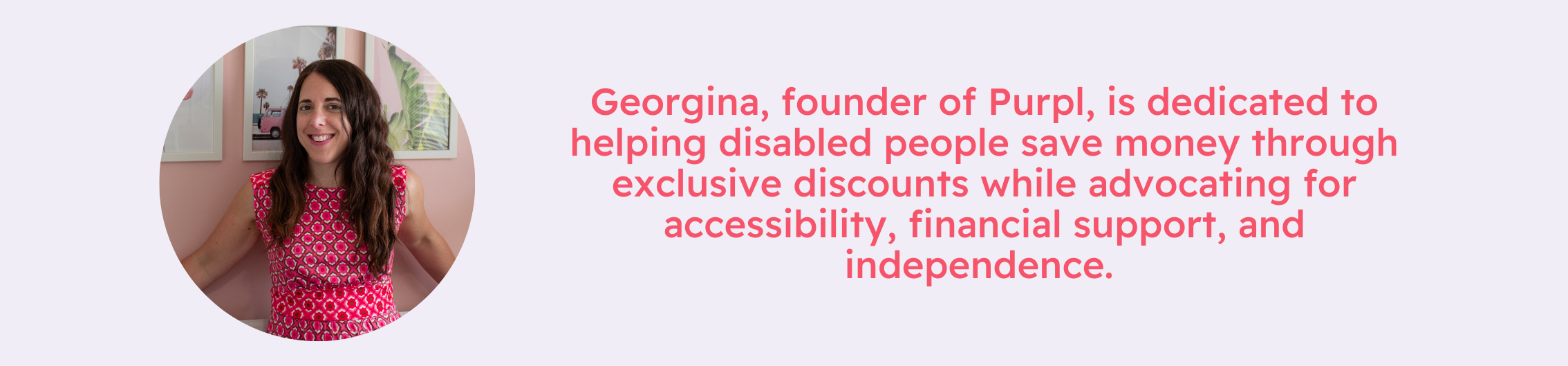
Georgina is the founder of Purpl, a platform dedicated to helping disabled people save money through exclusive discounts. Living with both Multiple Sclerosis (MS) and ADHD, she understands firsthand the financial challenges that often come with managing a disability. Because of this, her mission is to collaborate with brands to secure discounts that help ease the cost of essential products, services, and everyday expenses for the disabled community.
As an ambulatory wheelchair user, Georgina also knows how it feels to lose a sense of independence due to a disability. For that reason, she’s deeply passionate about using holistic therapies and diet to manage inflammation and stay as healthy as possible. Ultimately, her goal is to make Purpl a trusted, go-to resource for disabled people — one that provides not only discounts but also practical advice, emotional support, and genuine financial relief.
Beyond Purpl, Georgina has a long-term vision to launch a foundation that will offer grants and funding for disabled people who need additional financial support. Through this, she hopes to create lasting change, empowering others to live with dignity, confidence, and choice.
Follow @Purpldiscounts on social media for the latest disability discounts, financial advice, and accessibility resources.
Other articles, or links, you might find useful:
Is ADHD considered a disability in the UK?
Is autism considered a disability in the UK?
Is diabetes a disability in the UK?
Is dyslexia considered a disability in the UK?
Is OCD considered a disability in the UK?
Is agoraphobia considered a disability in the UK?
Is multiple sclerosis (MS) considered a disability in the UK