
Download the app


© 2026. The Purpl Co Limited. All rights reserved.


Download the app
© 2026. The Purpl Co Limited. All rights reserved.
7 min read
Written by
Georgina, Founder of Purpl
Published on
August 18, 2026
Last reviewed: 18 August 2026
Applies to: England
Written by: Georgina, Founder of Purpl
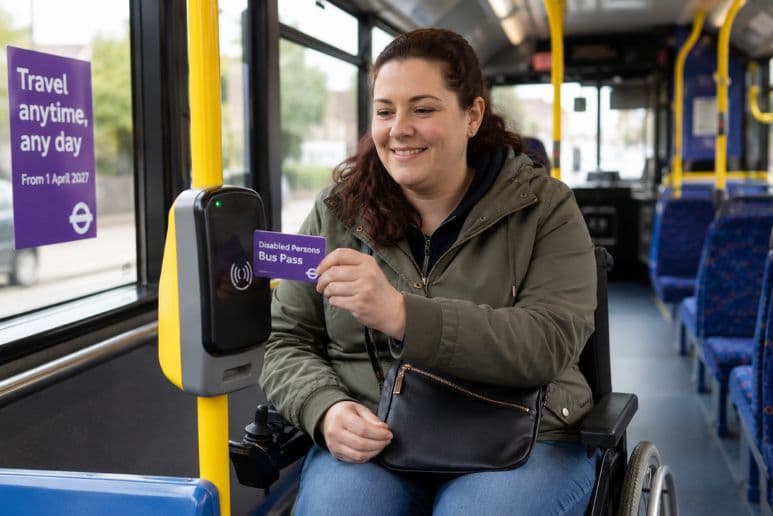
Disabled people in England will be able to use their concessionary bus passes at any time of day from 1 April 2027, after the Government announced it will scrap the national 9:30am weekday restriction.
At the moment, the English National Concessionary Travel Scheme gives disabled pass holders free local bus travel between 9:30am and 11:00pm on weekdays, plus all day at weekends and on bank holidays. Some councils already pay for extra hours out of their own budgets, but from April 2027 the morning restriction will be removed nationwide across England.
For disabled people who need to get to work, early hospital appointments, school, or simply get on with their day before 9:30am, this is a practical policy change that removes an unfair extra cost of disability.
From 1 April 2027, the Government plans to remove the time restriction that currently stops many disabled people using their concessionary bus pass for free before 9:30am on weekdays.
That means eligible disabled pass holders will be able to use local bus services covered by the scheme throughout the day, rather than having to wait until mid-morning or pay for an earlier journey. The Government has committed £60 million to funding the rollout, with £40 million coming from the Department for Work and Pensions and £20 million from the Department for Transport.
Crucially, this change gets rid of a long-standing postcode lottery.
Councils can currently choose to fund free travel before 9:30am themselves. Some do, while others stick strictly to the national minimum. That means two disabled people with identical travel passes can face completely different costs simply because they live in different areas. Department for Transport guidance confirms that councils have always had the option to offer these additional concessions locally, but from April 2027, every disabled person in England will share the exact same 24/7 travel entitlement.
Founder’s insight (Georgina):
“Disabilities do not wait until 9:30am to start, so restricting travel support to off-peak hours was always discriminatory and out of touch with real life. Disabled people need to get to early NHS appointments, commute to work shifts, and access their communities just like anyone else. Scrapping this arbitrary rule gives disabled people back their basic independence, dignity, and flexibility while removing an unfair peak-fare tax on those who can least afford it.”
The national change officially starts on 1 April 2027.
That date is important because headlines saying the restriction has been “scrapped” can easily give the impression that you can start using your pass before 9:30am today. For most of England, you cannot yet.
Until the new rules take effect, the default national entitlement remains:
It is always worth double-checking with your issuing council before travelling early on social media news alone, particularly if you are making a journey outside your usual local area.
My immediate reaction to this announcement was simple: finally.
I have never understood why disability support should operate according to a clock. My MS doesn’t suddenly start at half past nine, and neither does anyone else’s disability. People have early hospital appointments, morning work shifts, school runs, and caring responsibilities. Having to pay simply because you needed to travel early never felt fair.
Anyone who regularly attends NHS clinics knows they don’t conveniently begin after 10:00am. Blood tests, scans, physiotherapy, outpatient appointments, and treatments frequently require leaving home early. If the bus is your primary accessible way of getting there, paying out-of-pocket peak fares simply because your appointment falls before 9:30am adds an unnecessary financial penalty.
Disabled people work early shifts too. A concessionary pass isn’t much help with commuting if you have to pay for the exact bus that gets you to work on time. Removing the morning restriction means workers no longer have to choose between delaying their travel or paying peak fares out of their wages.
Sometimes the best time to travel is simply when your body allows you to. If you live with chronic fatigue, pain, or another fluctuating condition, waiting around for 9:30am can throw off your entire day. For many, an early start is easier; for others, travelling before buses become crowded makes the journey far more manageable.
Disabled households already face substantial additional daily expenses. Paying for a bus journey that would have been completely free 30 minutes later is a frustrating extra cost that builds up over the month.
Greater Manchester provides a clear picture of why the Government decided to take this policy nationwide.
The city-region trialled all-day concessionary bus travel in August and November 2025, allowing around 400,000 older and disabled people to use their passes without waiting for 9:30am. Following the success of these pilots, Greater Manchester permanently removed the morning restriction on Bee Network buses from 1 March 2026.
Current Bee Network guidance confirms that disabled person’s travel pass holders can travel free on buses within Greater Manchester at any time of day.
Interestingly, the Greater Manchester trial highlighted that removing the restriction wasn’t just about saving pass holders money. Local evidence showed that the old rule created artificial crowding around 9:30am because people deliberately delayed their travel to avoid paying peak fares. Scrapping the curfew smoothed out bus demand while letting disabled residents travel according to their own lives rather than an arbitrary clock.
Eligibility isn’t based solely on whether you have a specific diagnosis name. Under the Transport Act 2000, you qualify for an English National Concessionary bus pass if you meet one of seven statutory disability categories:
| Statutory Category | Description and Required Evidence |
| 1. Blind or partially sighted | Registered as sight impaired or severely sight impaired with a CVI certificate. |
| 2. Profoundly or severely deaf | Audiology report confirming hearing loss of 70dBHL or greater in both ears. |
| 3. Without speech | Medical confirmation of being unable to communicate orally in any language. |
| 4. Substantial walking difficulty | Higher Rate Mobility DLA, or scoring 8+ points on PIP ‘Moving Around’. |
| 5. Loss of the use of both arms | Medical proof of complete long-term loss of arm function. |
| 6. Learning disability | State of arrested or incomplete development of mind, causing severe social and intelligence impairment. |
| 7. Refused a driving licence | Medical condition preventing a licence under Part III of the Road Traffic Act 1988 (e.g. uncontrolled epilepsy). |
Don’t rule yourself out simply because you don’t use a wheelchair or mobility aid. Statutory eligibility covers invisible disabilities, hearing and sight loss, learning disabilities, and medical conditions that prevent you from holding a driving licence.
Receiving PIP does not mean every claimant automatically receives a bus pass; what matters is your specific award descriptor breakdown.
For example, local councils accept a PIP award of 8 points or more under ‘Moving Around’ as proof of a substantial walking difficulty. Similarly, scoring 8 points or more under ‘Communicating Verbally’ can support an application under speech or hearing criteria.
If you don’t receive PIP, you are not automatically locked out. You can apply using medical evidence, audiology reports, or a letter from your specialist or GP.
You apply directly through the local council or transport authority responsible for concessionary travel where you live.
Not automatically under national rules.
The English National Concessionary Travel Scheme provides the statutory travel entitlement for the pass holder only. Free companion (or “+1”) travel is a discretionary local perk funded by individual councils, so rules vary depending on where you live.
If you cannot travel safely on public transport without support, specifically ask your local council whether they offer a companion pass alongside your standard pass.
When will disabled bus passes become valid before 9:30am across England?
The nationwide 24/7 travel entitlement officially takes effect on 1 April 2027. Until then, standard national rules (9:30am to 11:00pm weekdays) apply unless your local council funds extra hours.
Can I use my disabled bus pass before 9:30am right now?
It depends entirely on where you live. Some councils (such as Greater Manchester) already fund pre-9:30am travel locally, but the national requirement starts in April 2027.
Will I need a brand new physical bus pass in April 2027?
No. The change updates the electronic permissions linked to your pass. Your existing card will work automatically when tapped on ticket scanners at any time of day starting 1 April 2027.
Does an English disabled bus pass work in Scotland, Wales, or Northern Ireland?
An English pass covers local bus journeys within England and cross-border routes starting or finishing in England. However, internal travel entirely within Scotland, Wales, or Northern Ireland requires a pass issued by their respective devolved transport schemes.
Will older person’s bus passes also become 24/7 across England?
No. This £60 million government announcement applies specifically to disabled person’s bus passes. Older person’s passes remain subject to standard off-peak hours unless individual councils choose to extend them locally.
Do you automatically get a bus pass if you receive PIP?
Not automatically. Qualification depends on meeting statutory disability criteria, though a PIP award letter scoring 8+ points in relevant mobility or communication categories serves as standard qualifying proof.
From 1 April 2027, disabled people in England will finally be able to use their concessionary bus passes on local bus services without waiting for 9:30am.
The importance of this change lies in how ordinary it is. Disabled people need to get to work, attend medical appointments, study, care for family, and go about their daily lives before half past nine in the morning. Having a disability shouldn’t mean organising your schedule around an arbitrary clock on a bus scanner.
Georgina is the Founder of Purpl, a disabled-led UK discount platform created to help offset the extra cost of disability. Living with Multiple Sclerosis, she uses her lived experience to share practical, accessible guidance on disability benefits, household costs, travel rights, and health self-advocacy.
Disabled persons railcard rules are changing in 2026: What is means for disabled people in the UK
Accessible Travel in the UK: Your Guide to Booking Trains, Buses, Taxis and More
How do I check what disability benefits I can claim: Use our benefit checker to see what you can claim
Travel and adventure discounts for disabled people: Verified member savings on accessible holidays, airport parking, and day trips.