How to apply for Disabled Students’ Allowance (DSA): a step-by-step guide
Written by
Georgina, Founder of Purpl
Published on
May 9, 2026
Last reviewed: 9 May 2026 Applies to: UK Written by: Georgina, Founder of Purpl
Disabled Students’ Allowance, often called DSA, is extra support for higher education students who have study-related costs because of a disability, long-term health condition, mental health condition, neurodivergence, sensory impairment or specific learning difficulty such as dyslexia. It can help with support such as specialist equipment, assistive software, non-medical helpers, disability-related travel and other course-related support. DSA is not based on household income and does not need to be paid back.
If you are starting university, already studying, returning to higher education or supporting a disabled student as a parent or carer, this guide walks you through how to apply for DSA step by step. It also explains how Purpl can help with wider student costs, including disability discounts from Staples UK for stationery and study supplies, and UniKitOut for bedding, kitchenware and move-in essentials.
At a glance
Disabled Students’ Allowance helps with extra study-related costs caused by a disability, long-term illness, mental health condition or learning difference.
DSA is not means tested and does not need to be paid back.
In England, students can get up to £27,783 for the 2026 to 2027 academic year, depending on assessed needs.
You usually need evidence of your disability, health condition, mental health condition or learning difference.
You should not buy equipment before your needs assessment, because you may not be reimbursed.
Purpl can help disabled students, parents and carers save on wider student essentials through discounts from brands such as Staples UK and UniKitOut.
Starting university can feel exciting, but it can also feel overwhelming when you are disabled, neurodivergent, living with a long-term health condition or managing your mental health. You may need extra time to plan travel, arrange support, set up your accommodation, manage medication, access lectures, process information, communicate with tutors or cope with fatigue, pain, anxiety or sensory overload.
Many disabled students do not get told about DSA early enough. You may still be able to apply after your course starts, but equipment, software, training and study support can take time to arrange. Applying early can make the start of term feel much less stressful.
Purpl Tip: Apply for DSA as early as you can, even if you are not completely sure what support you need yet. The process exists to help identify the right support for your studies.
What is Disabled Students’ Allowance?
Disabled Students’ Allowance is financial support for higher education students who have extra study-related costs because of a disability, long-term health condition, mental health condition, learning difference or other disability-related need.
DSA can help with things such as:
Specialist equipment, for example a computer if you need one because of your disability.
Assistive technology or software.
Non-medical helpers, such as a specialist note taker, mentor or British Sign Language interpreter.
Extra travel to attend your course or placement because of your disability.
Other disability-related study support, such as additional printing for proof-reading or accessible materials.
DSA does not usually cover costs that every student has, or disability-related costs you would still have if you were not studying. It is designed to reduce study barriers linked to your disability, not to replace general student finance.
Purpl Insight: DSA is study support, not general living cost support. It can make university more accessible, but disabled students may still face extra costs for food, transport, accommodation, equipment, heating, bedding, stationery and everyday essentials.
Who can apply for Disabled Students’ Allowance?
You may be able to apply for DSA if you are a higher education student and you have a disability, long-term health condition, mental health condition, neurodivergence, sensory impairment or specific learning difficulty that affects your ability to study.
Examples of conditions or support needs that may qualify include:
Dyslexia, dyspraxia, ADHD or autism.
Anxiety, depression, PTSD or another mental health condition.
Chronic pain, chronic fatigue, Crohn’s disease, diabetes, epilepsy or another long-term health condition.
Mobility impairments.
Visual or hearing impairments.
A physical disability.
A fluctuating condition that affects study, attendance, travel or concentration.
You do not need to receive Personal Independence Payment (PIP) or another disability benefit to apply for DSA. The decision focuses on your study-related needs, not whether you already receive disability benefits.
Purpl Tip: Do not talk yourself out of applying because you think you are “not disabled enough”. If your condition affects your ability to study, travel, attend lectures, concentrate, communicate, read, write, process information or manage deadlines, it is worth checking your eligibility.
How much Disabled Students’ Allowance will I get?
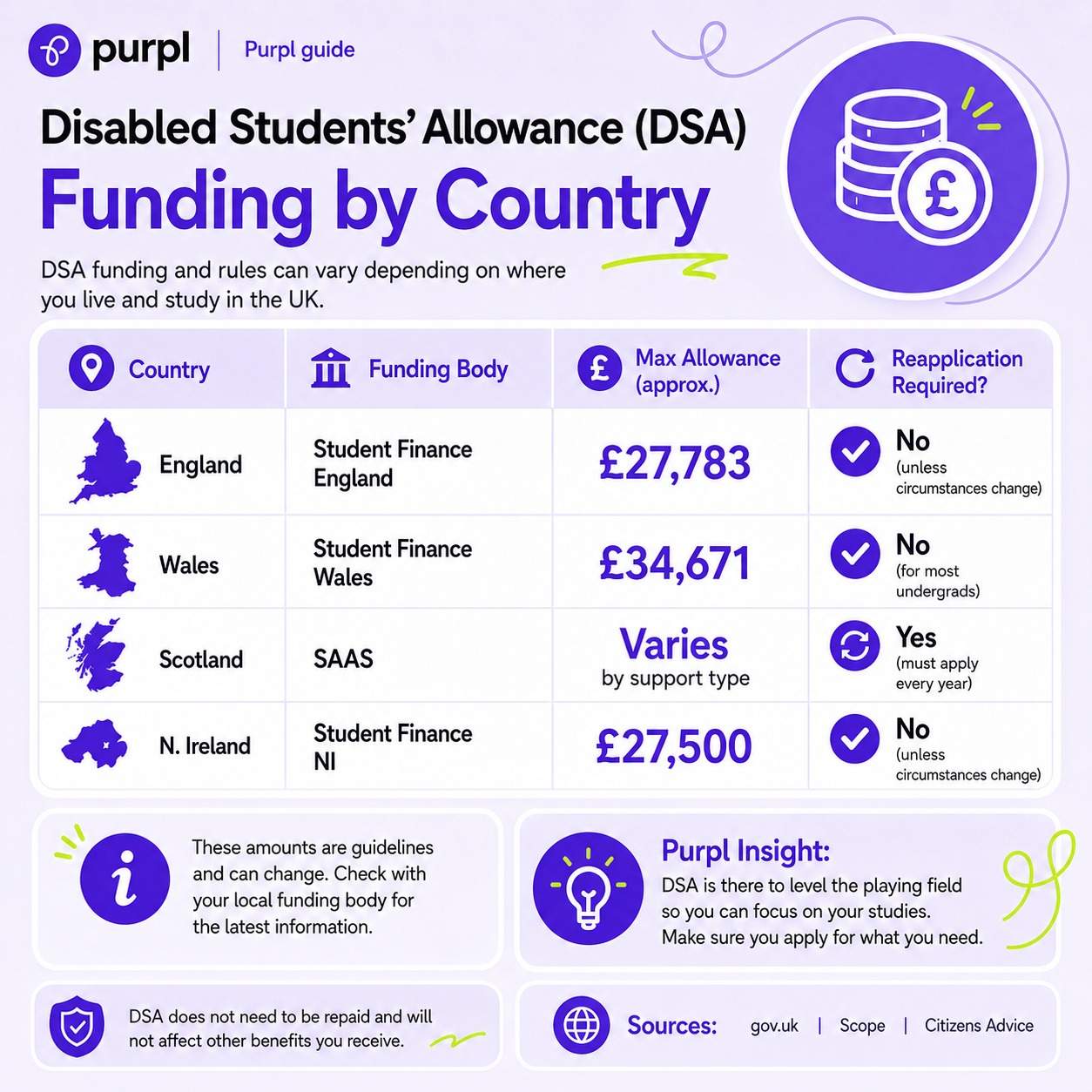
The amount of Disabled Students’ Allowance you can get depends on your individual study needs, not your household income. In England, students can get up to £27,783 for the 2026 to 2027 academic year, depending on what support is recommended after their DSA needs assessment.
This does not mean every student will get the maximum amount. One student may only need assistive software, while another may need specialist equipment, mentoring, travel support or non-medical helper support.
DSA funding and rules can vary across England, Wales, Scotland and Northern Ireland, so you should always check the official guidance for where you normally live before applying.
DSA funding and rules can vary depending on where you normally live in the UK.
Purpl Tip: Focus on explaining what support you need to study, not on the maximum allowance figure. Your needs assessment helps decide what support is right for you.
How to apply for Disabled Students’ Allowance
Step 1: Check where you need to apply
Where you apply usually depends on where you normally live in the UK, not only where your university is based.
Most students apply through one of these routes:
England: apply through Student Finance England.
Wales: apply through Student Finance Wales.
Scotland: apply through the Student Awards Agency Scotland, known as SAAS.
Northern Ireland: apply through Student Finance Northern Ireland.
In Scotland, students apply through SAAS. SAAS advises students to apply as soon as possible so funding can be available at the start of the course. For the 2026 to 2027 academic year, the closing date for DSA applications is 31 March 2027, and students need to apply for DSA for each year of their course (https://www.saas.gov.uk/guides/disabled-students-allowance/how-to-apply).
Purpl Insight: The earlier you apply, the better chance you have of getting support in place before your course starts. Waiting until term begins can add stress when you are already managing lectures, deadlines, accommodation and health needs.
Step 2: Gather your evidence
You usually need evidence that confirms your disability, health condition, mental health condition or learning difference.
The evidence you need may depend on your condition. You may be asked for:
A letter from your GP, consultant, specialist nurse or mental health professional.
A diagnostic report for a specific learning difficulty.
Evidence from a psychologist, psychiatrist or another qualified professional.
A disability evidence form completed by a medical professional.
Existing medical letters or reports that explain how your condition affects daily life or study.
Your evidence should explain how your condition affects your studies, not just state the diagnosis. This might include difficulties with reading, writing, processing speed, memory, concentration, attendance, fatigue, pain, mobility, sensory processing, communication, mental health, organisation or travel.
Purpl Tip: When you ask for medical evidence, explain that you need it for Disabled Students’ Allowance and ask the professional to describe the impact on your study, travel, attendance or day-to-day functioning.
Step 3: Submit your DSA application
Once you know where to apply and have your evidence ready, submit your DSA application through the correct student finance body.
You may need to provide:
Your personal details.
Your course details.
Your student finance reference number, if you have one.
Information about your disability or condition.
Evidence of your condition.
Consent for relevant information to be shared between Student Finance, your university or college disability service and DSA suppliers.
Purpl Insight: Giving permission for your student finance body and university disability service to share relevant information can reduce delays, but you should still read the consent wording carefully and only share what you feel comfortable sharing.
Use the assessment to explain what studying is really like for you. You can talk about:
Reading, writing, spelling or processing speed.
Concentration, fatigue, pain or flare-ups.
Lecture attendance and note taking.
Sensory overload, anxiety or panic.
Placement travel or campus travel.
Deadlines, organisation and memory.
Assistive software or equipment.
Support workers, mentoring or study skills support.
Remote learning needs.
Exam or assessment adjustments.
You do not need to make your condition sound better than it is. The assessment works best when you explain the difficult days, not just the days when you manage.
Purpl Tip: Before your needs assessment, write a list of what makes studying harder. Use real examples, such as “I miss information in lectures”, “I cannot sit at a desk for long”, “I struggle to travel during flare-ups” or “I need extra time to process written information”.
Step 5: Wait for your entitlement letter
After your needs assessment, Student Finance reviews the recommendations and sends a decision After your needs assessment, Student Finance reviews the recommendations and sends a decision about what support you can receive.
Your entitlement letter should explain:
What equipment or software has been approved.
Whether you need to contribute towards a computer.
What training or support you can access.
Whether non-medical helper support has been recommended.
Whether travel support or other study-related costs have been approved.
Which suppliers you need to contact.
Whether payments go directly to suppliers or to you.
Purpl Tip: Keep your entitlement letter somewhere safe. You may need it when speaking to suppliers, your university disability team, your needs assessor or Student Finance.
Step 6: Arrange your equipment, software and support
Once your entitlement letter arrives, follow the instructions carefully. Some suppliers may contact you directly, while in other cases you may need to contact them yourself.
Warning: do not buy equipment before your assessment, as you may not be reimbursed.
Your approved support may include:
A laptop or computer, if approved.
Assistive software.
Ergonomic equipment.
Specialist chairs or desk equipment.
Recording tools.
Specialist study skills support.
Mental health mentoring.
Note taking support.
BSL interpreting.
Mobility-related travel support.
Training on how to use assistive technology.
If the recommended support does not meet your needs, speak to your assessor, university disability team or student finance body. You can ask questions, explain what is missing and check whether your needs can be reviewed.
Purpl Insight: DSA equipment and support can take time to arrive. Keep emails, note dates, chase politely and ask your university disability team for help if anything gets stuck.
Step 7: Use Purpl discounts to reduce wider student costs
DSA can help with disability-related study costs, but it will not cover every cost of student life. Disabled students may still face extra spending on travel, food deliveries, accessible equipment, bedding, heating, laundry, medication storage, stationery, printer ink, home study set-ups and practical items for student accommodation.
That is where Purpl can help. Purpl gives disabled people, people with long-term health conditions, parents and carers access to disability discounts on everyday essentials. For student life, Staples UK and UniKitOut are especially useful.
Staples UK sells office supplies, stationery, paper, ink, toner, furniture and home office essentials, which can help disabled students create a more comfortable study set-up at home, in halls or in supported accommodation.
UniKitOut sells student starter kits and move-in essentials, including bedding, towels, kitchenware, bathroom items and student room products, which can help reduce the stress of preparing for university accommodation.
Purpl can help disabled students save on:
Stationery, notebooks, folders and pens.
Printer paper, ink and toner.
Desk items and home study supplies.
Bedding, towels and kitchen packs.
University move-in essentials.
Practical items for parents and carers supporting a disabled student.
Before buying, check the live Purpl brand pages for the current Staples UK and UniKitOut disability discounts, because discount amounts, terms and expiry dates can change.
Purpl Tip: Before you buy student essentials, check Purpl first. Small savings on stationery, bedding, kitchen packs and home study supplies can add up when disability already makes student life more expensive.
Frequently asked questions (FAQs) about Disabled Students’ Allowance
What is Disabled Students’ Allowance used for?
Disabled Students’ Allowance can help pay for extra study-related costs caused by a disability, long-term health condition, mental health condition or learning difference. This can include specialist equipment, assistive software, non-medical helpers, extra disability-related travel and other study support.
Do you have to pay Disabled Students’ Allowance back?
No. Disabled Students’ Allowance does not need to be paid back, and it can be paid either on its own or alongside other student finance.
Is Disabled Students’ Allowance means tested?
No. DSA is not based on household income. The support you receive depends on your individual study needs.
How much Disabled Students’ Allowance can I get?
The amount you can get depends on your assessed needs. In England, students can get up to £27,783 for the 2026 to 2027 academic year, but not everyone will receive the maximum amount. DSA rules and funding levels can vary across the UK, so always check the guidance for where you normally live.
Can I get DSA for ADHD, autism or dyslexia?
Yes, you may be able to apply if ADHD, autism, dyslexia or another neurodivergence or learning difference affects your ability to study.
Can I apply for DSA if I have anxiety or depression?
Yes, you may be able to apply if a mental health condition affects your study. DSA can support students with study-related costs because of a mental health problem, long-term illness or another disability.
Do I need a diagnosis to apply for DSA?
You usually need evidence of your disability, health condition, mental health condition or learning difficulty. For students in England, there are DSA application forms and disability evidence forms available online, but the disability evidence form cannot be used to confirm a specific learning difficulty.
What happens at a DSA needs assessment?
A DSA needs assessment looks at what support can help you complete your studies. It is not a test. It helps identify the equipment, software, support workers, training or other study-related help you may need.
Should I buy a laptop before my DSA assessment?
No. You should not buy equipment before your DSA needs assessment, because you may not be reimbursed.
Can Purpl help disabled students save money?
Yes. Purpl helps disabled people and people with long-term health conditions access discounts on everyday essentials. For students, Purpl discounts from brands such as Staples UK and UniKitOut may help reduce costs on stationery, study supplies, bedding, kitchen packs and move-in essentials.
In summary
Disabled Students’ Allowance can make university more accessible if you are studying with a disability, long-term health condition, mental health condition, neurodivergence, sensory impairment or learning difference. It can help with specialist equipment, software, non-medical helpers, study support and extra disability-related travel.
The steps are easier once you break them down. Check where you need to apply, gather your evidence, submit your DSA application, attend your needs assessment, wait for your entitlement letter and then arrange your approved support.
DSA can help with study-related barriers, but it does not cover every cost of student life. Purpl can help disabled students, parents and carers save on practical essentials through disability discounts from brands such as Staples UK and UniKitOut, helping make university life a little more affordable.
About the author
Georgina is the founder of Purpl, a UK disability discount platform created to help disabled people and people with long-term health conditions save money on everyday costs. Purpl exists because life with a disability often costs more, and too many people are left to manage benefits, education, work, healthcare and daily living costs without enough support.
Through Purpl, Georgina shares practical guides, lived experience, money-saving support and disability-focused information to help disabled people, carers, families and students across the UK.