
Download the app


© 2026. The Purpl Co Limited. All rights reserved.


Download the app
© 2026. The Purpl Co Limited. All rights reserved.
12 min read
Written by
Georgina, Founder of Purpl
Published on
October 20, 2026
Last reviewed: 20 October 2026
Applies to: England, Wales and Northern Ireland
Prepared by: The Purpl Team
What is included in Purpl’s free Child DLA toolkit?
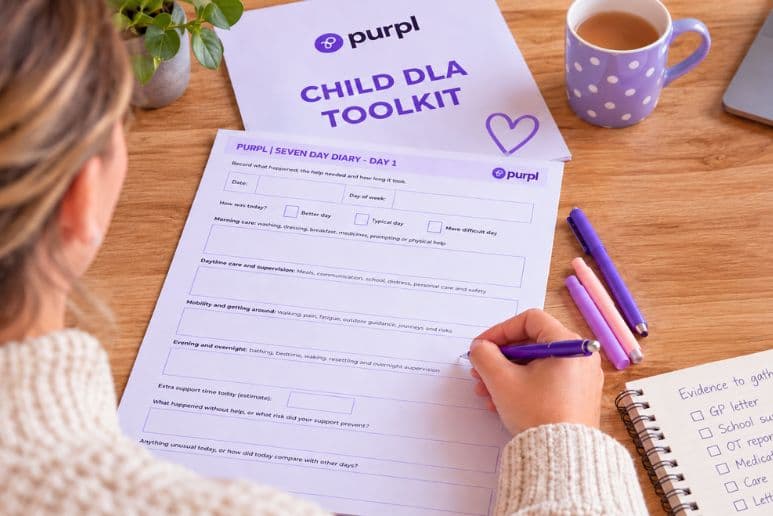
Purpl’s free Child DLA toolkit includes evidence checklists, a seven-day care diary, a completed fictional example, supporting letter templates for schools and healthcare professionals, and a final application checklist. It helps parents record their child’s additional care, supervision and mobility needs when preparing a Disability Living Allowance application.
Applying for Disability Living Allowance (DLA) for your child can feel overwhelming, particularly when you’re trying to explain just how much extra care and support they need every day.
As a parent or carer, you probably do many things automatically. You might help your child get dressed, supervise them around roads, manage sensory difficulties or spend hours helping them settle at night. When these things become part of your normal routine, it’s easy to forget just how much additional support you’re providing.
This toolkit will help you gather evidence, record your child’s daily needs and request supporting information from professionals involved in their care.
You don’t need a formal diagnosis to apply for Child DLA. What matters is how your child’s disability or health condition affects their everyday life, particularly whether they need substantially more care or supervision than another child of the same age, or have difficulties getting around.
The toolkit is suitable for children with physical disabilities, long-term health conditions, learning disabilities, autism, ADHD, sensory impairments and other additional needs.
Important: This toolkit supports applications for Child DLA in England, Wales and Northern Ireland. In Scotland, families apply for Child Disability Payment instead.
We’ve created this free toolkit to make gathering evidence for your child’s DLA application a little easier.
You can read the guidance below or download a printable copy to complete at your own pace. It includes an evidence checklist, seven-day care diary, practical examples, letter templates for requesting supporting information and a final application checklist.
Download the free Child DLA evidence toolkit (PDF)
You don’t need to complete everything at once. Start with the sections most relevant to your child and return to the toolkit whenever you need it.
You don’t need every document on this list. The aim is to gather information that helps explain your child’s needs clearly.
A few detailed pieces of evidence showing the support your child requires can be more useful than a large collection of medical letters that only confirm a diagnosis.
Gather any relevant information from professionals who understand your child’s condition and support needs.
Evidence checklist:
☐ GP or paediatrician letters
☐ Autism, ADHD or other diagnostic assessment reports
☐ Occupational therapy (OT) assessments
☐ Speech and language therapy (SALT) reports
☐ Physiotherapy assessments or treatment plans
☐ Child and Adolescent Mental Health Services (CAMHS) reports
☐ Audiology or ophthalmology reports
☐ Hospital discharge summaries or consultant letters
☐ Current medication or repeat prescription information
☐ Reports about specialist equipment, aids or adaptations
☐ Referral letters or evidence of ongoing assessments
What makes this evidence useful?
Look for information explaining how your child’s condition affects everyday activities.
For example, a report confirming autism may provide useful background, but a report explaining that your child needs constant supervision because they have limited awareness of danger gives a clearer picture of their care needs.
Purpl Tip: If your child is waiting for an assessment or diagnosis, don’t assume you have to wait before applying. Evidence of their existing difficulties and support needs can still be relevant.
Schools and nurseries can provide valuable information about the additional support your child needs outside the home.
Evidence checklist:
☐ Education, Health and Care Plan (EHCP), if applicable
☐ SEN Support Plan or Individual Education Plan (IEP)
☐ Individual Development Plan (IDP), if applicable in Wales
☐ Statement of Special Educational Needs, if applicable in Northern Ireland
☐ SENCO or ALNCo supporting statement
☐ Teacher or teaching assistant observations
☐ School risk assessments
☐ Behaviour or incident records
☐ Personal care or medical support plans
☐ Records of additional supervision or one-to-one support
☐ School attendance information where relevant to your child’s condition
Ask the school to explain:
Purpl Tip: A child who manages well at school may still have significant difficulties at home. Explain any differences between settings, including exhaustion, distress or increased support needs after school.
This is often one of the most useful parts of a Child DLA application.
Keep a diary showing what you actually do for your child and how their needs compare with those of another child of the same age.
Evidence checklist:
☐ Washing, bathing and personal hygiene
☐ Getting dressed and undressed
☐ Toileting and continence support
☐ Eating, drinking and mealtime supervision
☐ Communication support
☐ Medication and treatment routines
☐ Help managing distress, anxiety or sensory difficulties
☐ Supervision to prevent accidents or injury
☐ Support with daily routines and transitions
☐ Bedtime difficulties and settling
☐ Night-time waking and care
☐ Assistance with specialist equipment
For each activity, try to explain:
Purpl Tip: Don’t overlook the support you provide to prevent problems. If your child remains safe because you’re constantly supervising them, that supervision is still important to record.
Child DLA also considers mobility difficulties, although the qualifying rules depend on your child’s age and circumstances.
The lower-rate mobility component is generally available from age five, while the higher-rate component can be awarded from age three if the relevant criteria are met.
Evidence checklist:
☐ Difficulty walking or moving around
☐ Pain, fatigue or physical discomfort when walking
☐ Falls, poor balance or coordination difficulties
☐ Use of mobility aids or specialist equipment
☐ Difficulty navigating unfamiliar places
☐ Additional guidance or supervision outdoors
☐ Limited awareness of traffic or other dangers
☐ Becoming overwhelmed or distressed when travelling
☐ Difficulty following directions or understanding safety instructions
☐ Records of relevant incidents or accidents
Useful information to record:
Purpl Tip: Be specific about your child’s difficulties. For example, rather than simply writing “struggles with walking”, explain how far they can walk, what happens afterwards and what assistance they need.
Evidence doesn’t have to come exclusively from medical professionals.
Someone who regularly cares for your child may be able to describe their needs in a way that supports your application.
People who could provide a statement include:
☐ Grandparents or other relatives
☐ Childminders
☐ Respite carers
☐ Support workers
☐ After-school club staff
☐ Sports or activity leaders
☐ Other people who regularly supervise or care for your child
Ask them to describe specific situations they’ve witnessed rather than simply confirming that your child has additional needs.
Keeping a diary for seven days can help you identify the additional care, supervision and mobility support your child needs.
If your child’s needs fluctuate considerably, you may find it helpful to continue for 14 days or longer.
Want to keep a record of your child’s daily care needs?
Download our free printable Child DLA toolkit and use the seven-day diary to record additional care, supervision, mobility difficulties and night-time support.
Remember: Record better days as well as more difficult days. Your evidence should give an accurate picture of your child’s needs, including how often difficulties occur.
Child’s name: __________________________
Date of birth: __________________________
Conditions or additional needs: __________________________
Diary start date: __________________________
Diary end date: __________________________
Use the following table as a guide. The examples are illustrative and should be replaced with your child’s actual experiences.
| Time or activity | Extra care or supervision needed | Difficulties or safety concerns | Additional time |
|---|---|---|---|
| Morning routine | Help choosing clothes, getting dressed and completing washing routines. Repeated verbal prompting needed. | Sensory discomfort with clothing. Becomes distressed when routines change. | 45 minutes |
| Breakfast | Food preparation, encouragement to eat and close supervision. | Restricted food choices and difficulties tolerating certain textures. | 30 minutes |
| Journey to school | Continuous supervision and physical guidance near roads. | Limited awareness of traffic and difficulty coping with unexpected noise. | 20 minutes |
| After school | Support to manage exhaustion and emotional distress. | Needs a quiet environment and adult reassurance before participating in other activities. | 60 minutes |
| Evening routine | Assistance with bathing, changing clothes and preparing for bed. | Sensory difficulties and problems moving between activities. | 45 minutes |
| Bedtime | Repeated reassurance and help settling. | Anxiety, difficulty sleeping and leaving the bedroom repeatedly. | 90 minutes |
| Overnight | Wakes several times and needs help settling safely. | May become distressed or wander around the house without supervision. | 60 minutes |
Important: The time recorded should reflect the support actually needed. Where possible, distinguish between the total time spent on an activity and the additional time required because of your child’s needs.
1. What additional help did your child need today?
2. Were there any difficulties with personal care, communication or daily routines?
3. Did your child need additional supervision to stay safe?
4. Were there any mobility difficulties, pain or fatigue?
5. Did your child need support during the night?
6. Was today a better day, a typical day or a more difficult day?
7. Was there anything unusual that affected your child’s needs today?
At the end of the week, look back through your diary.
Number of days additional care was needed: ______
Number of nights additional care was needed: ______
Typical additional care or supervision time each day: ______
Main difficulties experienced:
Examples of situations where additional supervision was necessary:
How your child’s needs varied throughout the week:
You can use this information when completing the DLA claim form or preparing additional supporting evidence.
One of the biggest challenges with a DLA application is explaining care needs in enough detail.
Try to avoid short statements that don’t explain what support is required.
Instead of:
“My child struggles to get dressed.”
Explain:
“My child needs repeated verbal prompting and physical assistance to get dressed each morning. They find certain clothing textures distressing and cannot complete the routine independently. Getting dressed usually takes around 45 minutes and requires an adult to remain with them throughout.”
Instead of:
“My child has no road awareness.”
Explain:
“My child does not reliably recognise traffic dangers and needs continuous adult supervision when outdoors. They have previously attempted to cross roads without checking for vehicles. I need to remain close enough to intervene immediately to keep them safe.”
Instead of:
“My child doesn’t sleep well.”
Explain:
“My child wakes approximately three times a night and needs an adult to help them settle. They become distressed and may leave their bedroom without supervision. Each waking usually requires around 20 minutes of reassurance and support.”
Instead of:
“My child gets tired when walking.”
Explain:
“My child experiences pain and significant fatigue when walking. After approximately 50 metres, they often need to stop and rest. Longer journeys require additional assistance, and they may be unable to continue walking without significant discomfort.”
These examples show the difference between describing a difficulty and explaining the practical impact.
Only use descriptions that accurately reflect your child’s experiences.
Need to request supporting evidence?
The toolkit includes two ready-to-use letter templates: one for your child’s school or nursery and another for their GP or healthcare professional.
You can copy and adapt the wording below, or download the full toolkit to keep the templates with your other application paperwork.
Download the Child DLA letter templates (PDF)
You can copy and adapt the following letters when requesting supporting information.
Subject: Supporting evidence request for Child DLA application – [Child’s name]
Dear [Name],
I am currently preparing an application for Disability Living Allowance (DLA) for my child, [Child’s name], and would be grateful if you could provide a short supporting statement about the additional help and supervision they need during the school day.
The DLA application looks at how much extra care or support a child needs compared with other children of the same age, so it would be particularly helpful if you could include examples of the support [Child’s name] receives.
Where relevant, could you please comment on:
If you have any existing documents that may be useful, such as a SEN Support Plan, EHCP, IDP, risk assessment or relevant observations, I would also appreciate copies where available.
Please don’t feel you need to prepare a lengthy report. A short statement with practical examples of the support provided would be extremely helpful.
Thank you for your time and for the support you provide to [Child’s name].
Kind regards,
[Your name]
[Contact details]
Subject: Request for supporting information – Child DLA application for [Child’s name]
Dear [Name],
I am currently applying for Disability Living Allowance (DLA) for my child, [Child’s name], and am gathering relevant information about their health conditions and additional care needs.
I understand that DLA considers how a child’s disability or health condition affects their everyday life, rather than relying solely on a diagnosis.
I would be grateful if you could provide copies of any relevant existing reports or a brief clinical summary, where possible, covering:
I appreciate that some of this information may already be available in existing medical records, so copies of relevant letters or reports would also be very helpful.
Thank you for your assistance.
Kind regards,
[Your name]
[Contact details]
Please note: Some GP practices charge for letters prepared specifically for benefit applications. You may be able to use existing medical records, clinic letters or reports instead.
Before sending your application, check that you’ve included enough information to explain your child’s needs.
☐ I’ve completed the relevant sections of the DLA claim form.
☐ I’ve explained the additional care my child needs compared with other children their age.
☐ I’ve included real examples of their everyday difficulties.
☐ I’ve described any additional supervision needed to keep them safe.
☐ I’ve explained relevant mobility difficulties.
☐ I’ve included information about night-time care, where applicable.
☐ I’ve explained how often support is needed and how needs vary.
☐ I’ve gathered relevant medical or professional evidence.
☐ I’ve included school or nursery evidence where available.
☐ I’ve included my care diary or a summary of the most relevant examples.
☐ I’ve checked that my supporting evidence is consistent with the information on the form.
☐ I’ve kept copies of my completed application and supporting documents.
☐ I’ve checked the submission instructions and any relevant deadlines.
You do not need to delay your application indefinitely while waiting for every possible supporting document. Check the instructions for your claim and seek advice if you’re unsure what to send.
You can find the official Child DLA guidance and application form here:
Child DLA eligibility and application guidance:
https://www.gov.uk/disability-living-allowance-children
Download the Child DLA application form:
https://www.gov.uk/government/publications/disability-living-allowance-for-children-claim-form
Families in Northern Ireland can apply for Child DLA using the relevant Department for Communities forms.
Child DLA application and guidance:
https://www.nidirect.gov.uk/publications/dla-child-claim-form-and-guidance-notes-dla1
In Scotland, Child Disability Payment has replaced Child DLA for new applications.
Child Disability Payment:
https://www.mygov.scot/child-disability-payment
Contact:
https://contact.org.uk
Contact provides specialist information and advice for families with disabled children, including guidance on completing DLA applications.
Citizens Advice:
https://www.citizensadvice.org.uk
Citizens Advice can help families understand benefit entitlement and access further support.
Yes. Your child doesn’t necessarily need a confirmed diagnosis to qualify for Disability Living Allowance (DLA).
What matters is the additional care, supervision or mobility support they need because of their disability or health condition. If your child is waiting for an autism, ADHD or other assessment, you can still apply and provide evidence of how their difficulties affect everyday life.
No. An Education, Health and Care Plan (EHCP) isn’t required to claim Child DLA.
An EHCP, SEN Support Plan or other educational evidence can help explain your child’s needs, but not having one doesn’t prevent you from applying.
Child DLA considers your child’s care and mobility needs, not whether they receive additional support at school.
Yes. A care diary can be useful supporting evidence because it shows what everyday life is actually like for your child.
Record the additional help you provide with personal care, communication, supervision, mobility and night-time needs. Include how often support is required, how long it takes and what might happen without it.
Our free Child DLA toolkit includes a printable seven-day diary and a completed example to help you get started.
No. It’s important to give an accurate picture of your child’s needs, including better days, typical days and more difficult days.
If their needs fluctuate, explain how often difficulties occur, what makes them worse and how much additional support is needed during those periods.
You don’t need to exaggerate anything. Showing how your child’s needs vary can help the decision-maker understand the support they require over time.
Your child’s needs at school may be very different from their needs at home.
Some children manage throughout the school day but become exhausted, overwhelmed or distressed afterwards. Others may need significant support with personal care, routines or staying safe outside school.
Explain these differences in your application, using real examples. Evidence from parents, carers and other people who regularly support your child can also help show the additional care they need.
No. Purpl’s free Child DLA toolkit is designed to help you prepare your application, but it doesn’t replace the official DLA claim form.
It includes evidence checklists, a seven-day care diary, a completed fictional example, supporting letter templates and a final application checklist.
You can use these resources to organise your evidence and explain your child’s needs more clearly when completing the official application.
For the official forms and guidance, visit GOV.UK for England and Wales or nidirect for Northern Ireland. Families in Scotland should apply for Child Disability Payment instead
You know your child better than anyone.
The extra support you provide might feel completely normal because it’s something you do every day. But that doesn’t mean it should be overlooked when explaining your child’s care needs.
Try to describe what everyday life actually looks like, including the things you do to prevent difficulties, the support your child needs to complete activities and how their needs change from day to day.
You don’t need to exaggerate or focus only on the most difficult moments. The strongest evidence gives a clear, honest picture of the additional care, supervision and mobility support your child needs.
Your child’s needs matter, and taking the time to explain them properly can help the decision-maker understand the support they require.
You don’t have to organise everything in one sitting. Our free Child DLA evidence toolkit brings the checklists, diary and letter templates together so you can work through them at your own pace.
Download your free Child DLA evidence toolkit (PDF)
For more guidance, read our Child DLA evidence guide to understand what information to include and how to explain your child’s additional needs.